Survival meter
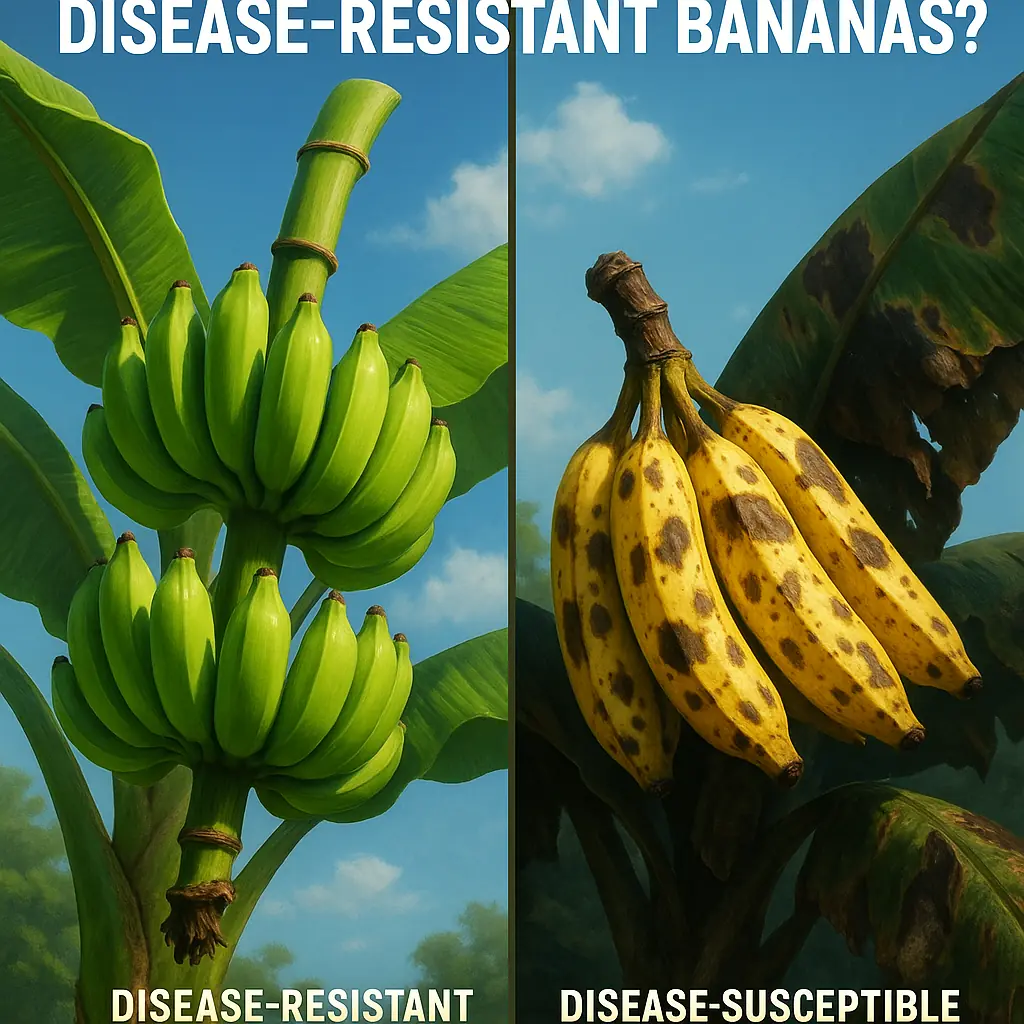
Bananas are everywhere in the grocery store but they are also an agricultural house of cards. Global trade runs on a single clone, the Cavendish, and that uniformity makes bananas dangerously vulnerable to fungal and viral diseases. If scientists managed to breed broadly disease-resistant bananas, that would be a big deal for food security, for banana farmers, and for tropical ecosystems. It would not be a miracle cure, and it could create its own problems.
Here’s a clear-eyed look at how resistant bananas could be created, how fast they might roll out, what could go wrong, and what people on the ground would actually need to do to keep the gains lasting.
Timeline of consequences
Lab breakthroughs and targeted field trials
Breeders and molecular biologists identify resistance genes from wild banana relatives and from other plants. CRISPR and transgenic methods are used to insert or tweak genes that limit fungal colonization or block pathogen toxins. Somaclonal variation and accelerated crossing programs produce candidate lines with improved tolerance.
Small, contained field trials begin in several countries. Researchers test agronomic performance, taste, and how well resistance holds up under real-world pathogen pressure. Regulatory dossiers start to take shape for varieties developed by different methods.
Regulatory review, initial adoption by commercial plantations
Some disease-resistant varieties clear regulatory hurdles in countries with established biotech frameworks. Large exporters and commercial plantations adopt them first because they can absorb certification and market risk. Smallholder adoption is slower due to cost, seedling supply, and local preferences for traditional varieties.
Surveillance networks detect any weakening of resistance. Farmers and researchers start to catalog pathogen strains to monitor for adaptation. Extension services push integrated disease management alongside new varieties.
Wider adoption, pathogen counter-adaptations, and diversification
Resistant cultivars reduce losses from Panama disease TR4 and severe leaf diseases like Black Sigatoka in many areas. Yield and income improve for farmers who get access and training. At the same time, pathogen populations put selective pressure on single-gene resistances. Some strains evolve to partially overcome those defenses.
Where resistance begins to erode, growers who relied solely on the new cultivars suffer setbacks. That prompts a shift toward stacking multiple resistance mechanisms, agroecological practices, and increased varietal diversity on farms.
A more resilient banana industry, or a new arms race?
Two plausible broad outcomes diverge. In one, a mix of genetic resistance, diversified plantings, and improved soil and sanitation practices produces a durable reduction in disease risk and stabilizes banana production across many regions.
In the other, pathogens keep adapting. Resistance gets patched with new edits and crosses, creating an ongoing arms race that keeps research and regulatory costs high. Social and economic inequalities determine who benefits most from the advances.
What science says
Bananas used for export are mostly sterile triploid clones. That makes them tasty and seedless, but it also blocks classic crossbreeding. Traditional breeding relies on rare fertile diploid relatives, long backcrosses, and lots of patience. Molecular tools change the equation.
There are several technical routes to resistance. One is to find resistance genes in wild Musa species and transfer them into commercial types. Another is to edit the banana genome to disable susceptibility genes that pathogens exploit. A third is to introduce antimicrobial peptides or pathogen-recognition receptors from other plants.
Each approach has trade-offs. Single resistance genes can be very effective at first, but pathogens evolve. Quantitative resistance, which combines many small-effect changes, is harder for a pathogen to overcome but also harder to breed and test. Bananas are clonally propagated, so once a resistant line is released it can be multiplied quickly, but the same clonality amplifies the risk of uniform failure if resistance breaks down.
There are non-genetic tools too. Biological controls, soil management, and fungicide rotations reduce pressure on both plants and the pathogens. Integrated strategies that combine genetics and agronomy will give the best chance at lasting control.
Environmental and ecological concerns need attention. Because commercial bananas produce little pollen and seed, gene flow is limited, but not zero. Wild Musa populations could be exposed to novel genes, and shifts in microbial communities are possible. Every new line needs ecological testing as part of its evaluation, not after it leaves the nursery.
Could anything survive?
A disease-resistant banana won't change civilization or human survival, but it could be a meaningful win for millions of people who depend on bananas for calories and income. How to get the win and keep it:
- Pair genetics with practices. Require integrated disease management plans when resistant cultivars are distributed. Sanitation, crop rotation where possible, and targeted fungicides matter.
- Don't rely on a single gene. Breeders should stack multiple resistance mechanisms and combine major-effect genes with quantitative resistance. That slows pathogen adaptation.
- Support smallholders. Build seedling nurseries, subsidize initial costs, and preserve traits local farmers value, like cooking quality and storage life.
- Monitor pathogen populations. Set up regional surveillance and rapid-sequencing labs to detect emerging strains. Early warning gives time to switch strategies before widespread failure.
- Maintain genetic diversity. Preserve wild Musa species and heritage cultivars in gene banks. Encourage on-farm varietal mixtures to reduce epidemic spread.
- Use regulatory and market tools. Traceability, labeling, and benefit-sharing agreements can ensure access and ethical deployment.
Success is social as much as scientific. The technology can work, but only with good stewardship, funding for monitoring, and policies that keep small farmers in the loop.