Survival meter
Trucks do most of the heavy lifting in modern cities. If they vanished, the whole food system would get ugly fast. Groceries, restaurants, and hospitals depend on a flow of pallets, refrigerated vans, and overnight couriers. Replace that flow and you keep the lights on. Fail and people go hungry, prices spike, and waste balloons.
Here’s a realistic playbook for the infrastructure cities would need to keep food moving when trucks are gone. Short fixes, medium fixes, long fixes. No fluff, just the hardware, logistics and policy cities would actually have to build.
Timeline of consequences
Emergency triage and rationing
Expect immediate disruption at distribution centers and supermarkets. Shelves go thin within days for fresh produce and meat. Municipal priorities should be clear: hospitals, eldercare, and critical institutions get first access.
Actions to start now:
- Open emergency food distribution centers at existing public facilities.
- Freeze nonessential shipments and redirect refrigerated rail cars and barges to hospital hubs.
- Authorize temporary use of municipal vehicles and charter buses for bulk staff and perishable movement.
Set up micro-hubs and repurpose streets
Expect ad hoc solutions to multiply. Cities that act fast will build a backbone for longer-term change.
- Create urban consolidation centers near railheads, river ports and on the periphery. These are transfer points where large shipments are split into small loads.
- Repurpose curb lanes for cargo-bike and electric trike corridors, and convert a percentage of parking to loading bays for micro-dispatchers.
- Deploy refrigerated shipping containers in key neighborhoods as temporary cold storage.
Modal shift and cold-chain expansion
Short-term fixes give way to more durable investments. Rebuilding the last mile is where most time and money will go.
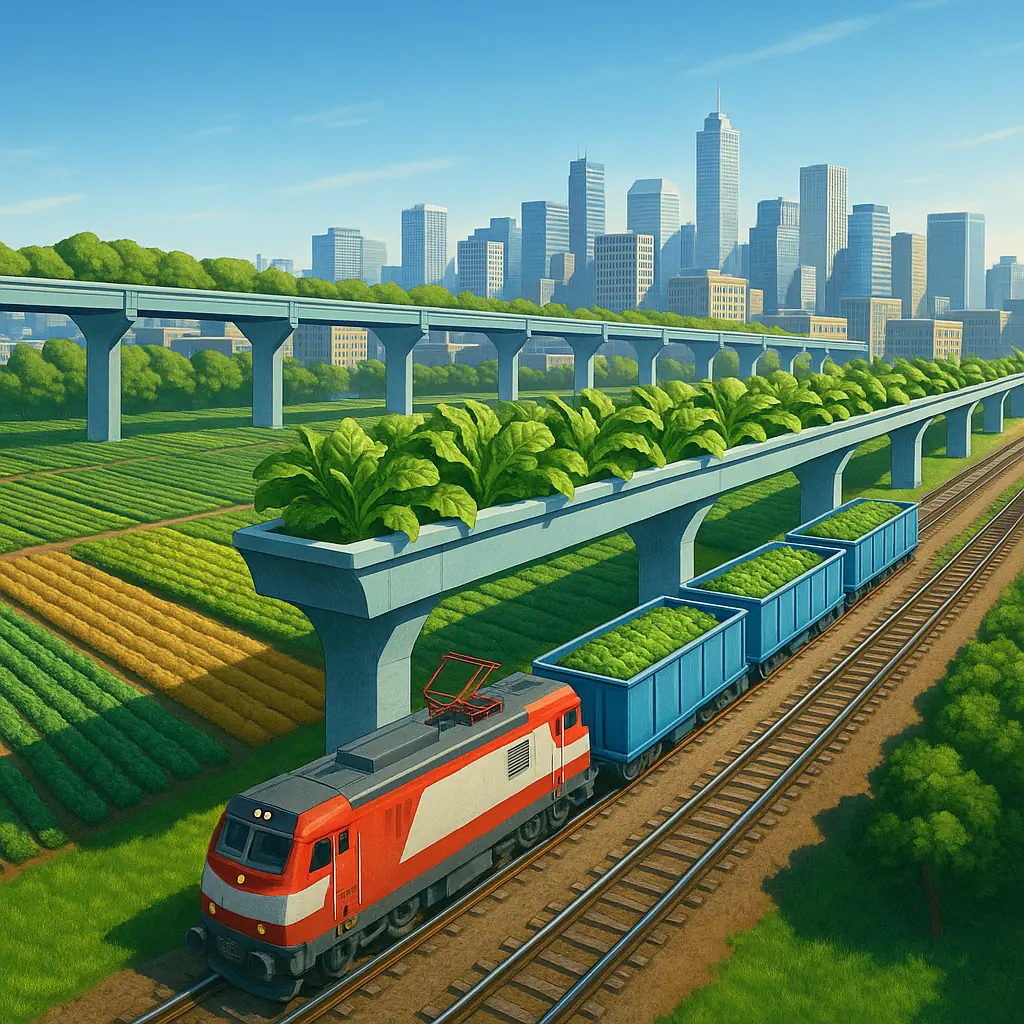
- Invest in rail freight spurs into food terminals, including refrigerated rail cars and terminal cranes for container handling.
- Build permanent urban consolidation centers with standardized pallets and conveyors to speed transfers from rail and river to cargo bikes and light freight trams.
- Roll out city-scale cold-storage networks and controlled-atmosphere rooms to cut spoilage.
A new urban food system
Physical and regulatory changes start to lock in. The food supply is resilient, but different.
- Dense, distributed food hubs across neighborhoods reduce the need for long haul movement of perishable items.
- Scaled rooftop and vertical farming supply supplements for leafy greens and herbs, lowering daily fresh demand on long supply chains.
- Dedicated light-rail and canal cargo lanes handle predictable bulk flows, while electric cargo fleets and autonomous ground vehicles run last-mile links.
What science says
Why are trucks so central? They are flexible, fast and door-to-door. In many countries trucks handle roughly three quarters of land freight by weight. Replace that flexibility by combining modes and densifying endpoints.
Key physics and math you need to plan for:
- Throughput. A single freight train can carry the equivalent of 50 to 300 trucks depending on length and cargo. Rail and barges are efficient for long-haul bulk but not for door-to-door last-mile delivery.
- Last-mile cost. Most delivery cost and delay sits in that last 5 to 50 kilometers. Without trucks the per-kilometer cost rises unless you invest heavily in micro-distribution points and labor-efficient couriers.
- Cold chain dynamics. Perishables spoil at rates that depend on time and temperature. For fruits and leafy greens, every hour outside target temperatures increases decay and microbial growth. Expanding refrigerated storage and reducing transfer time between modes directly cuts waste.
- Load geometry. Standardized, palletized containers let you swap modes fast. Cities need conveyors, forklifts, and cranes tuned to 20- and 40-foot containers, plus smaller standardized bins for cargo bikes and trikes.
- Energy and emissions. Rail and barges are more energy efficient per ton-kilometer than trucks, but electrifying the last mile with bikes, trams and small EVs shifts the energy burden rather than eliminating it. Urban agriculture reduces transport energy but raises local energy and nutrient cycling needs.
Alternatives have constraints. Cargo bikes typically carry 100 to 300 kilograms and average 12 to 25 kilometers per hour in urban traffic. Drones can work for tiny, high-value items but are tiny in throughput and weather-dependent. The physics favors a hybrid: efficient bulk to the hinterland, then dense micro-hubs and human-powered or light-electric last-mile delivery.
Could anything survive?
Practical blueprint for city managers and planners. These are the infrastructure and policy moves that actually keep people fed.
- Urban consolidation centers: Fund and fast-track permits for a ring of transfer hubs near rail terminals, ports and major transit nodes. Make them refrigerated and modular.
- Cold-storage network: Incentivize private and municipal cold rooms positioned in or near neighborhoods. Use controlled atmosphere for fruit and blast-freezing for meat and fish.
- Repurposed streets: Rezone curb space for cargo corridors and micro-hub loading. Prioritize cargo-bike lanes and timed delivery windows.
- Standardization: Mandate interoperable pallets, bins and digital manifests so goods move between barges, trains, conveyors and bikes without reboxing delays.
- Legal and financial tools: Offer tax credits for companies converting empty retail space into micro-distribution hubs. Temporarily subsidize freight rail and barge use for food shipments.
- Local production: Scale urban greenhouses, vertical farms and peri-urban market gardens focused on high-turnover crops like leafy greens and herbs. They won’t replace calories from grains and meat but they cut daily fresh demand.
- Community resilience: Support community kitchens, bulk buying cooperatives and farmers markets to decentralize distribution and reduce reliance on single supermarkets.
- Workforce and maintenance: Train a corps of logistics technicians for transshipment equipment, cold-chain maintenance and cargo-bike fleets. Keep spare parts inventory for refrigeration and handling equipment.
- Data and prioritization: Implement real-time inventory systems with priority tagging for hospitals and shelters. Use dynamic routing to reduce idle time and keep cold chains intact.
Short-term triage and long-term planning must run in parallel. You can reroute a pallet to a barge today. Building a citywide cold-chain and micro-hub network takes years. Both are needed to truly feed a city without trucks.