Survival meter
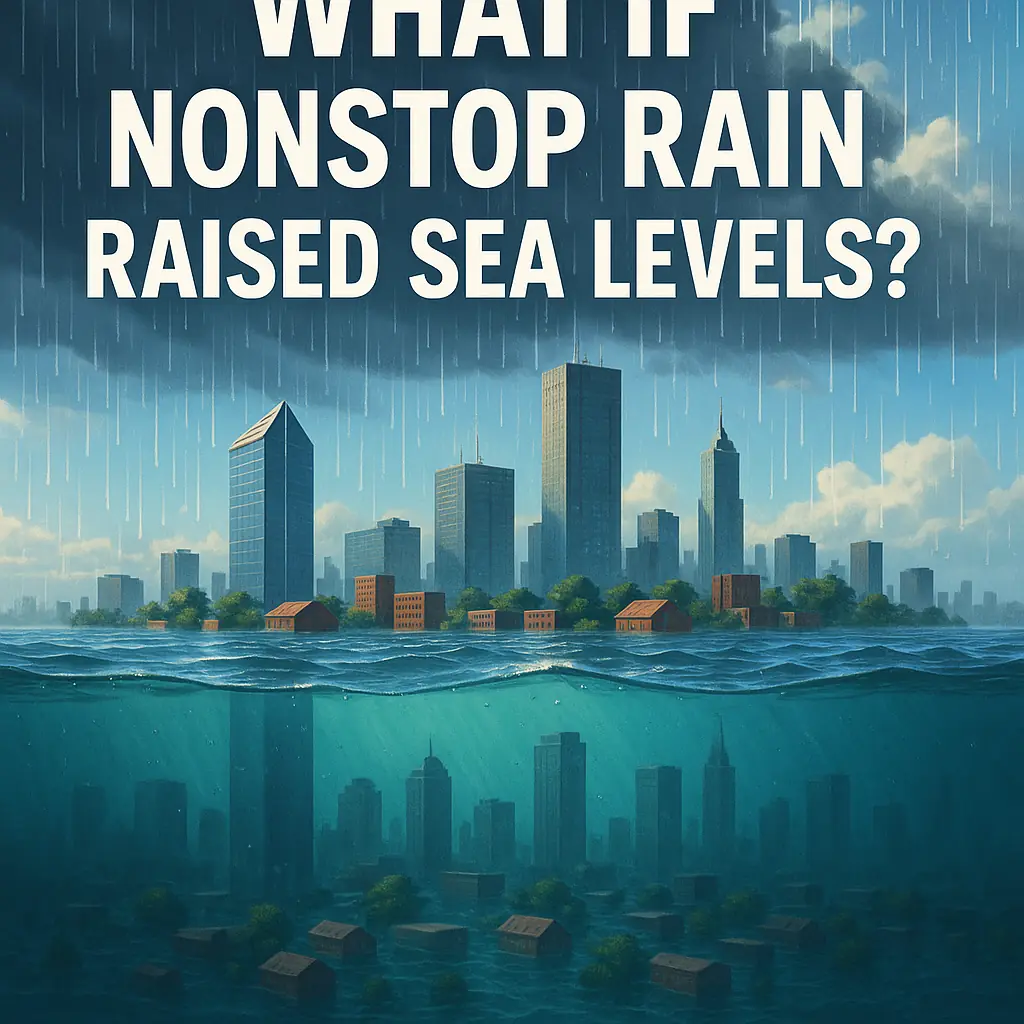
Imagine it never stops raining. Drizzle at dawn. Downpours at midnight. Weeks blur into months under a sky that keeps pouring. If that happened, would the oceans swell noticeably? Would coastal cities drown? The short answer is yes, in some scenarios. The long answer is messier, because where the rain falls and where the water comes from make all the difference.
Below I walk through how nonstop rain could change sea levels, how realistic it is, the likely timeline of impacts, and what people and societies would actually need to do to cope.
Timeline of consequences
When the roof blows off: flash floods and immediate chaos
Continuous heavy rain produces fast-moving hazards. Streets turn to rivers. Drainage systems back up. Basement and subway flooding begins within hours in dense cities. Emergency services get overwhelmed.
Expect power outages and localized structural collapse where soils saturate quickly. Short-term fatalities come from drowning, vehicle accidents, and hypothermia in poorly prepared populations.
Rivers fail, dam reservoirs overflow, soils stay sodden
After weeks of nonstop rain the hydrological system shifts. Rivers crest and stay high. Reservoirs fill and spill. Groundwater rises; septic systems and foundations fail. Agricultural fields lose productivity from waterlogging and root rot.
Vector-borne and water-borne diseases proliferate. Supply chains fray as roads and rail lines are repeatedly washed out. Temporary shelters swell into semi-permanent camps.
Where the water ends up: gradual sea level rise
If the rain keeps coming for years and most of it runs off to the ocean, sea levels will rise. How much depends on volume. One useful figure: adding 1 millimeter of global sea level requires about 361 cubic kilometers of water spread across the ocean surface.
So persistent, planetwide excess runoff on the order of tens of thousands of cubic kilometers per year would be needed to add tens of centimeters of sea level in a few years. That is a huge amount of net water transfer to the ocean, but the scenario is mechanically possible if the extra precipitation is supplied continuously from increased evaporation or an external water source.
Coastal retreat, salt intrusion, and economic shock
Coastlines adjust to higher water. Low-lying urban zones, airports, ports, and industrial complexes become regularly flooded. Freshwater aquifers near the coasts become salinized. Agricultural land near shore loses value.
Insurance markets collapse in exposed regions. Governments either pay for massive, expensive defenses or authorize managed retreat. Expect mass migration from vulnerable coastal belts, with the resulting social and political stress concentrated in inland urban centers.
A new coastline and ecological turnover
Given sustained sea level rise, tidal wetlands migrate, coral reefs drown if they cannot keep up, and salt-tolerant habitats expand inland where elevation and substrate allow. Cities that do not relocate become ghost towns. Economies that depend on coastal access reorganize or shrink.
Where freshwater was scarce before, saltwater intrusion rewrites land use. Fisheries shift as shallow continental shelves change. Persistent rain itself complicates recovery by eroding soils and preventing reconstruction.
What science says
Sea level is set by the volume of water in the oceans. Rain is only one way water moves around the Earth’s surface and atmosphere. Precipitation over the ocean is mostly a wash in terms of sea level because water falling back into the ocean is just returning where it came from. For sea level to rise from rain you need net transfer of water from land reservoirs into the ocean or an increase in total planetary water.
Where does nonstop rain come from? The atmosphere holds a limited amount of water, and global evaporation from the ocean refills it. The capacity of the air to hold moisture increases roughly 7 percent per degree Celsius of warming, so a warmer planet can produce heavier storms and more precipitation in some places. Still, climatic physics limit how much extra rain the system can sustain. You can get intense, prolonged storms, but you cannot get arbitrarily more water out of the atmosphere without increasing evaporation.
There are three realistic mechanisms that could cause the kind of prolonged, large-scale rain needed to move huge volumes of water into the ocean:
- Amplified hydrological cycle from warming. Warmer oceans evaporate more, fueling heavier and longer rainfall events. Regional patterns would vary; some areas would get drier while others get much wetter.
- Melting of continental ice. Ice sheets and glaciers add fresh water to rivers and oceans as they melt. That water often shows up as increased river discharge and, eventually, sea level rise. The delivery mechanism may look like persistent runoff, though it is technically meltwater rather than direct rainfall.
- External water input. A large comet or asteroid delivering significant water, or massive release of subterranean water from geological processes, could add new freshwater to the system. Those are low-probability scenarios, but they would directly increase ocean volume.
Some simple math keeps things real. One millimeter of global sea level equals about 361 cubic kilometers of water. If nonstop rain produced an extra 36,100 cubic kilometers of runoff to oceans in a year, that would be roughly 10 centimeters of sea level rise in a single year. Not trivial, but getting to that magnitude through rainfall alone requires enormous and sustained shifts in evaporation and precipitation patterns or an external source of water.
Could anything survive?
Short answer, the people who survive are the ones who move to higher ground and secure fresh water. The communities that fare best prepare ahead and have resources for relocation. Here is a practical checklist for households, planners, and local governments.
- Find elevation. If you live within a few meters of current sea level, identify and plan to move to areas at least tens of meters higher if the worst-case scenario is decades-long. Temporary barriers help but are rarely sufficient for long-term sea level rise.
- Protect freshwater. Saltwater intrusion ruins groundwater. Invest in sealed wells, move intakes inland, and deploy desalination where feasible. Rainwater harvesting offsets some needs, but persistent contamination and standing water complicate treatment.
- Adapt agriculture. Shift to raised beds, switch to salt-tolerant crops, and decentralize food production. Urban agriculture and vertical farms reduce dependence on vulnerable coastal plains.
- Health and sanitation. Prevent disease spread by repairing sewage systems and ensuring clean water distribution. Mosquito control and vaccination campaigns reduce secondary mortality after flooding.
- Infrastructure and power. Elevate substations, move critical facilities inland, and harden transport links. Decentralize energy generation and add portable microgrids for resilience.
- Plan migration. Managed retreat is expensive but often cheaper and safer than ad hoc evacuation. Develop legal frameworks, land-use plans, and social safety nets to absorb displaced populations.
- Preserve natural defenses. Protect and restore wetlands and mangroves. They soak up incoming water, slow waves, and buy time for communities to adapt.
Individual survival is possible even if entire towns are lost. Collective survival depends on timely policy, funding, and the political will to move at scale.