Survival meter
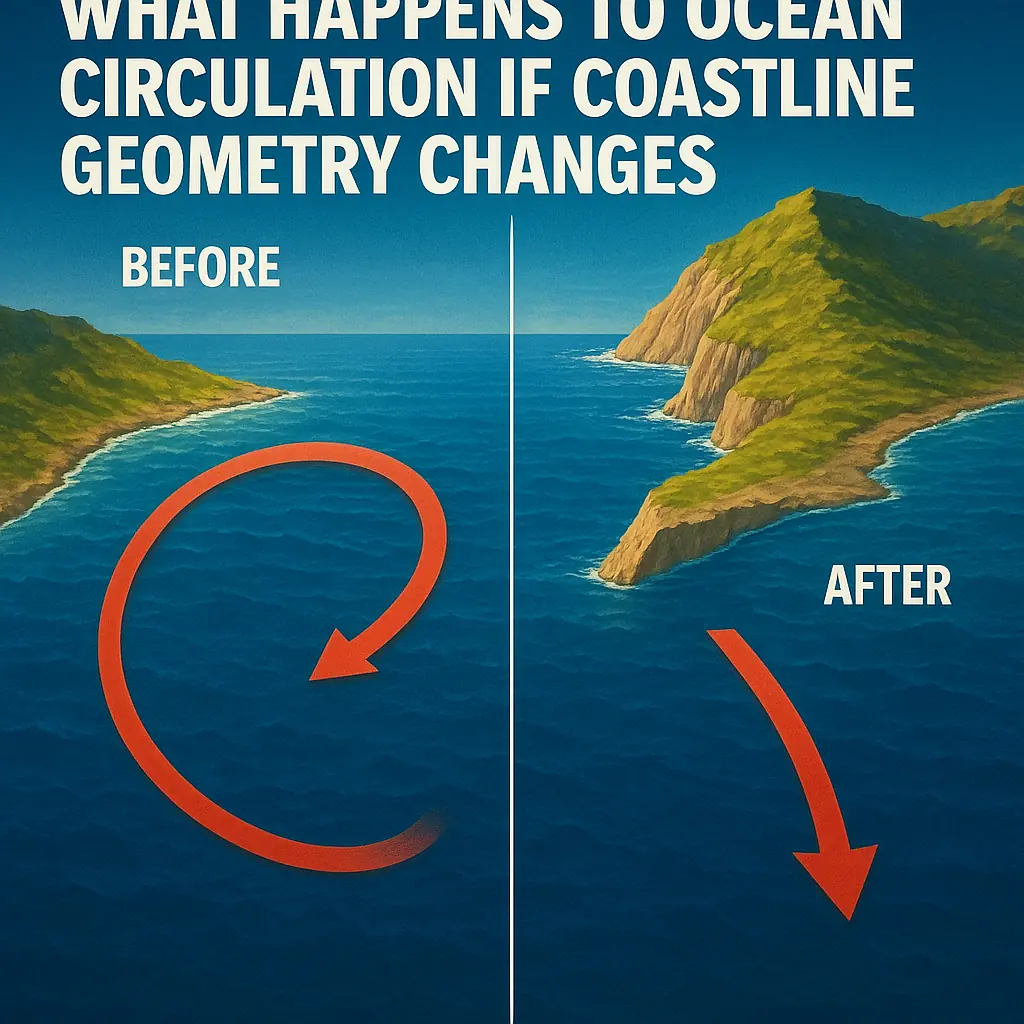
Coastlines are the interface where land sculpts the sea. Move the shape of that line and you change how currents form, where nutrients rise, and how heat is shuffled around the planet.
Imagine continents with smoother edges, new peninsulas, a dozen new straits, or hundreds of kilometers of flooded shelves. The ocean would not simply shrug and carry on. Currents would rearrange, storms would ride different highways, and fisheries would follow new rules.
Timeline of consequences
Local shock, immediate rebalancing
Coastal changes from storms, human land reclamation, or rapid sea level rise first alter local water flows. Estuaries and bays see salinity and stratification shift within months. Shoreline narrowing speeds currents in some channels and chokes them in others. Tidal resonances can jump, amplifying or damping tides in sheltered embayments.
Fishing grounds close to shore respond quickly. Species that rely on shelf-retained larvae get hit fast. Ports need to move or dredge to stay functional.
Regional rearrangement of gyres and upwelling
As shelf width and coastal curvature change across hundreds of kilometers, the ocean starts to reorganize on a basin scale. Wind-driven gyres and coastal upwelling regions shift position. Narrowing or widening of continental shelves alters how winds convert to offshore transport, changing productivity along entire coasts.
New or closed straits start to modulate exchanges between marginal seas. Currents that used to hug a coast may detach at a new cape, spawning eddies that reorganize heat and nutrient transport for decades.
Large-scale circulation and climate feedbacks
When changes are persistent across multiple continental margins, the tally adds up. Basin-scale circulation responds to altered topographic steering and modified momentum balances. Pathways of Western Boundary currents like the Gulf Stream and Kuroshio can shift position slightly, altering where heat is delivered to midlatitudes.
If major seaways change, think an effectively closed strait where one used to exist, or a new deep channel opens, exchanges of water masses and freshwater budgets can alter the thermohaline circulation. The climate signal is modest on human timescales but can be significant regionally.
New equilibrium, slow ecological turnover
Over centuries, sediment redistribution, biological feedbacks, and continued tectonics or sea level trends produce a new steady state for circulation. Some ecosystems collapse and are replaced by others better suited to the new currents and nutrient regimes.
Long-lived climate effects may persist if major throughflows were changed. The fossil record shows that when the Isthmus of Panama formed, ocean circulation and climate shifted over thousands of years. Comparable coastline rearrangements could leave similarly long shadows.
What science says
Ocean circulation is not only wind and density. Shorelines, shelves, and straits are active players. A few physical rules explain why.
- Topographic steering. Flow likes to follow the path of least resistance. Coastal curvature and continental slope guide boundary currents. Change the coast and you change where a current separates from the shore and where it sheds eddies.
- Shelf width and mixing. Wide continental shelves act as reservoirs and mixing zones. Narrow shelves force energy offshore, altering the generation of upwelling and the retention of planktonic larvae. That shifts fisheries and carbon uptake.
- Straits and throughflow. Narrow connections between basins act like valves. Their depth and width control exchange of heat, salt, and momentum. Even modest changes in gateway geometry can change the salinity budget of a whole ocean basin over decades.
- Tidal resonance and coastal amplification. Bays and inlets have natural frequencies. Geometry changes can push a coastal region closer to or further from resonance, changing tidal range and associated mixing by large factors.
- Wind-curl and basin geometry. Large-scale wind forcing produces gyres through vorticity budgets that depend on basin shape. Altering the coastline modifies the pathways of Rossby waves and the distribution of wind-driven currents.
Examples help. The closure of the Isthmus of Panama cut exchange between Pacific and Atlantic and helped strengthen the Atlantic circulation millions of years ago. Today, the Indonesian Throughflow moves warm water between basins; if its geometry were altered by sea level or tectonics, regional climates would shift. On a smaller scale, coastal engineering projects that straighten harbors have been shown to reduce local upwelling and lower productivity within months.
Caveats matter. Many circulation features are resilient because they are powered by the wind field and global density gradients. Coastline changes tend to rearrange patterns rather than flip the ocean into a completely different state, unless the change affects major gateways or is global in scale.
Could anything survive?
Humans are tied to coasts for food, transport, and cities. Expect impacts to be concentrated, rapid, and uneven.
- Fisheries. Upwelling shifts will move fish stocks hundreds of kilometers. Local fishers can lose catches quickly. Some stocks collapse, others appear in new places.
- Infrastructure. Ports, canals, and tidal power installations are geometry sensitive. Rising maintenance costs and relocation start within years for high-risk coasts.
- Food security. Regions that rely on coastal productivity for protein face supply shocks. Urban coastal populations need flexible supply chains.
- Navigation and shipping. New eddies and current pathways change transit times and fuel use. Narrowed channels raise the risk of grounding and accidents.
Practical steps:
- Invest in real-time coastal monitoring of currents, salinity, and bathymetry. The faster you see changes, the sooner you adapt.
- Design ports and coastal defenses for flexibility, not fixed line items. Movable breakwaters and modular quays ease transitions.
- Shift fisheries management from fixed-area quotas to dynamic measures that follow stock distributions.
- Restore and expand wetland buffers. They dampen storm surge and preserve local mixing regimes.
Probable outcomes split into likely and speculative. Likely outcomes include regional shifts in fisheries, increased port costs, and altered tidal amplitudes in some bays. Speculative but plausible outcomes occur if major gateways are altered: substantial shifts in large-scale heat transport and modest changes in regional climates over decades to centuries.