Survival meter
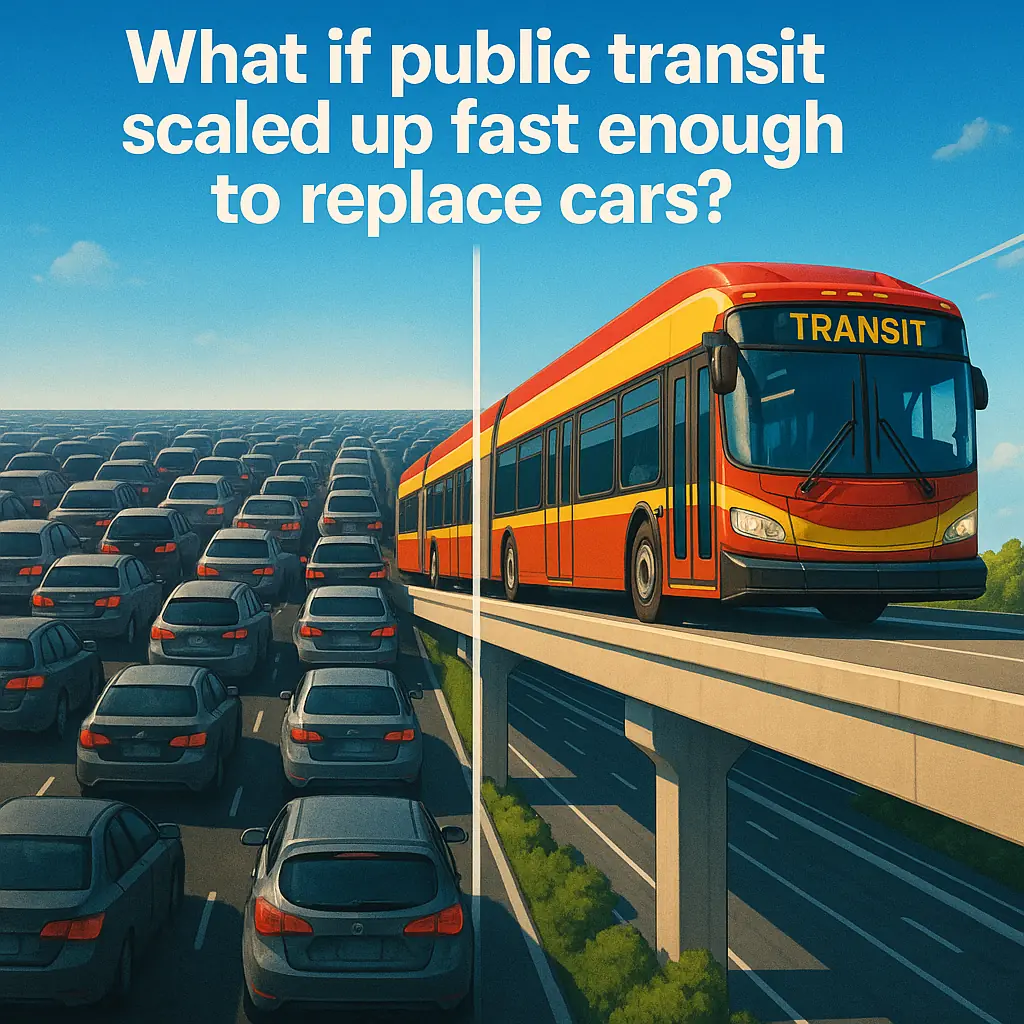
Imagine cities where private cars are rare, parking lots are lawns and curb space goes to people, not metal. Now imagine getting there fast, within a decade or two, rather than a lifetime. What would happen if public transit could be expanded quickly enough to take the place of most personal vehicles? The consequences would ripple through transport, energy, industry and daily life.
Below I map a plausible, evidence-based scenario: how the shift could unfold, the engineering and policy moves that would make it possible, who wins and who loses, and what society risks if the transition is botched.
Timeline of consequences
Shock, surge, and emergency deployment
Early provocations kick the shift into high gear. Sharp spikes in fuel prices, air pollution crises, or new urban pollution fines make driving costly. Municipal and national governments declare mobility emergencies and unlock funds. Transit agencies begin emergency interventions: reallocating curb lanes to bus rapid transit, launching unlimited-ride passes for low-income riders, and contracting temporary bus fleets to cover immediate demand.
Rapid regulatory fast-tracks allow transit agencies and private fleet operators to deploy more buses, convert buses to electric, and extend late-night and weekend service. Planners prioritize high-frequency corridors and connect suburbs with mainline rail and express buses.
Buildout, automation and cultural shift
Capital flows increase. Dedicated bus lanes, light rail extensions, and regional rail upgrades go from plans to projects. Cities repurpose street space and swap car parking for pop-up transit hubs. Public funding and climate bonds underwrite most projects. Electric buses and trains expand quickly because they scale on existing right-of-way and require less time to deploy than building new highways.
Automation starts to scale, mostly in the form of driver-assist and platooning on highways and priority corridors, reducing operating costs. Mobility apps integrate real-time schedules, on-demand shuttles and microtransit to solve the first-mile problem. Car sales fall in dense and mid-density areas as urban residents find transit more convenient and cheaper than owning a vehicle.
Market collapse for private ownership in cities
Transit becomes the default in most metropolitan cores. Auto-dependent retail and parking-dependent commercial real estate decline. Ride-hailing markets transition to fleets operated under contracts with transit agencies or municipal regulators. Auto manufacturing retools, with light vehicle demand dropping sharply; makers shift to commercial EVs, transit vehicles and mobility services.
Street redesigns become permanent: widened sidewalks, protected bike lanes, fewer traffic lanes and large public plazas where there used to be parked cars. Urban freight adapts with micro-distribution centers and freight trams or cargo bikes handling last-mile deliveries.
New urban normal and regional rebalancing
Car ownership is a minority choice inside most metro areas and rare in dense downtowns. Suburban and rural areas still keep private cars but rely on periodic mass transit links that allow long commutes without daily driving. Land use begins to reverse decades of sprawl incentives. Old parking structures get repurposed.
Climate benefits are substantial: transport emissions drop as electrified transit and fewer private cars reduce total vehicle miles traveled. Public health improves as air quality and physical activity increase. Political debates move from whether transit is desirable to how to maintain and finance it sustainably.
What science says
Scaling transit fast enough to replace cars is a systems problem, not a single invention. It requires capacity, energy, control systems and human factors to align.
- Throughput and frequency: You need high-capacity lines operating at short headways. Heavy rail and bus rapid transit can move tens of thousands of passengers per hour per direction when lanes, signals and boarding are optimized. The engineering question is expanding that capacity across many corridors simultaneously.
- Energy and electrification: Electric motors already dominate modern transit vehicles. The challenge is charging infrastructure and grid capacity. Smart charging, depot-to-grid management and targeted upgrades to distribution grids can enable rapid electrification without building entirely new generation in many regions.
- Automation and operations: Driverless trains exist and are increasingly reliable, but retrofitting networks and gaining public trust takes time. Short-term gains come from software: better dispatching, dynamic routing for microtransit, centralised fleet management and predictive maintenance to reduce downtime.
- Land use and first/last mile: Transit capacity only matters if people can reach stations. Dense, walkable development around stops, protected bike lanes and low-cost on-demand shuttles fill gaps. Cities must reprogram curb management and parking policy so buses and trams can keep schedules.
- Manufacturing and supply chains: Rapid scale-up demands global manufacturing capacity for vehicles, rails, signaling and batteries. Lead times for rail electrification and vehicle production are months to years, so parallel supply investments and flexible procurement strategies are required.
Could anything survive?
Replace the car at scale and several survival-relevant metrics improve. Fewer traffic fatalities, lower air pollution, and reduced fossil fuel exposure all reduce short-term human risk. On the other hand, the transition introduces vulnerabilities if it is uneven or underfunded.
- Human safety: Car crashes kill hundreds of thousands globally each year. High-quality transit lowers the exposure to those risks and encourages active travel, which reduces chronic disease. But overcrowding, sudden cuts to service or poorly maintained systems can create new harms.
- Civilizational resilience: A transit-first system is less dependent on liquid fuels and personal vehicles, which helps during fuel shocks. However, electrified transit concentrates dependency on electricity and supply chains for parts. Redundant routing, mixed propulsion strategies and decentralized microgrids reduce single-point failure risks.
- Ecological stability: Large reductions in vehicle miles traveled and the spread of electric fleets would cut greenhouse gas emissions and urban air pollutants. Rewilding former parking and road space improves local ecosystems and stormwater management. Rapid transition must avoid building throwaway infrastructure or shifting pollution elsewhere through raw material extraction.
Likely outcomes separate into probable and speculative. Probable: lower urban air pollution, fewer road deaths in dense areas and large changes in real estate use. Speculative: total elimination of private cars. That depends on political will, cultural acceptance and long-term financing.