Survival meter
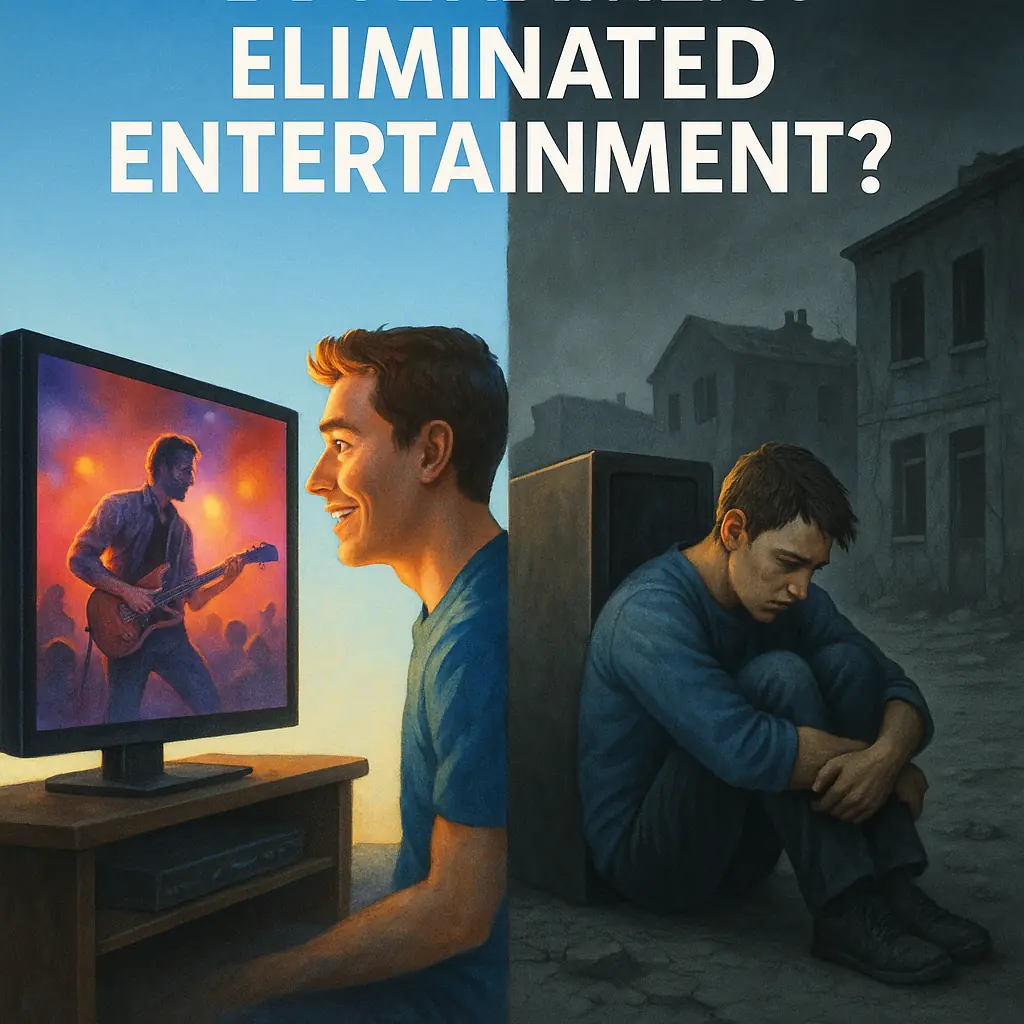
Imagine a world where movies, concerts, sports, novels, streaming, and video games are gone overnight. No more comedy shows, no more music at cafés, no more stadiums. Governments decide entertainment is a waste of resources, a distraction from national priorities, or a source of social unrest. The ban is legal, enforced, and comprehensive.
How would people react? What would break first, and what would survive? Below is a practical, evidence-informed sketch of how societies might fray, adapt, fight back, and rebuild in the absence of sanctioned amusement.
Timeline of consequences
Immediate shock and patchwork enforcement
Big media platforms go dark or are forced to delete content. Movie theaters and live venues close. Broadcasters pull entertainment programming and rerun informational or state-approved material. People show up at closed venues, confused or angry.
- Retailers and cafes that relied on background music and sports draws report empty seats.
- Illegal streams and private gatherings begin within hours. Apps and peer-to-peer networks reroute around official blocks.
- Policing focuses on public events. Online enforcement is noisy but incomplete.
Adaptation, boredom, and early underground culture
Households scramble for replacements. Board games, backyard sports, and amateur theater spike. Libraries and parks become more heavily used. Mental health hotlines see increased calls for anxiety and insomnia.
- DIY scenes grow fast. People trade home recordings, live house concerts, and printed zines.
- Black markets appear for contraband media, from pirated shows to illicit concerts in basements.
- Religious and community institutions step into the void, offering free gatherings that mix ritual and entertainment.
Economic strain, youth rebellion, and cultural substitution
Industries dependent on entertainment bleed jobs. Tourism drops where attractions vanish. Advertising revenue collapses and that ripples through newsrooms and social media. Teenagers and young adults push back, staging flash mobs, pop-up raves, and clandestine matches.
- Schools try to fill the gap with increased arts classes, but budgets are tight.
- Some governments ease restrictions to limit unrest, others double down and criminalize possession or sharing of banned material.
- New cultural practices emerge: communal reading nights, amateur orchestras, and competitive non-spectator sports like obstacle races.
Normalization of constrained pleasures and underground entrenchment
Society bifurcates. A visible, regulated public culture offers permitted content: state-sponsored pageants, educational spectacles, sanctioned sports. Parallel underground networks keep banned art alive. Enforcement becomes a costly cat and mouse game.
- Black markets professionalize, using encrypted channels and physical meetups.
- Some people pursue 'repair culture' and hands-on hobbies that replace passive consumption.
- Drug use and illicit gambling may increase in populations seeking intense stimulation.
Cultural drift and selective recovery
Generational effects appear. People who grew up without mainstream entertainment have different patterns of attention, memory, and socializing. Some cultural forms go extinct, while others mutate and flourish underground.
- Economic sectors reinvent themselves. Public spaces pivot to interactive education and communal arts.
- States that maintain the ban face brain drain, soft power loss, and creative capital deficits.
- International travel and black-market exchanges reintroduce banned works, slowly eroding the ban's effectiveness.
What science says
Entertainment is more than fun. It activates reward circuits in the brain, primarily dopamine pathways that reinforce learning, social bonding, and curiosity. Removing those predictable rewards changes behavior and physiology.
Short term, people feel boredom, frustration, and loss. Boredom is not harmless. It increases risk-taking, impulsive choices, and substance use in vulnerable individuals. Sleep schedules can shift too, because screens and social cues regulate circadian timing for many.
Over months, the brain adapts. People find alternate sources of reward that give similar reinforcement: exercise, crafting, community projects, or risky behaviors. Habit formation moves toward what is available and rewarded. That can be healthy, as when communities trade in-person games and cooperative projects, or harmful, as when illicit thrill-seeking spreads.
The social science is clear about a few patterns. Rituals and shared narratives reduce stress and cement group identity. Entertainment often serves that role, offering safe emotional rehearsal for conflict, satire, and empathy. Remove sanctioned outlets and those energies flow outward. They either reconverge into approved channels, stay private, or become oppositional. Where economic and political grievances already exist, removing entertainment becomes a spark rather than the sole cause of unrest.
Finally, cultural memory matters. Entertainment carries skills: storytelling, improvisation, musical competence. Suppressing those skills reduces creative industries, which underpins innovation in other sectors. The effect is slow but measurable when you look at patent rates, startup formation, and cross-disciplinary creativity over decades.
Could anything survive?
Individual coping is straightforward. Replace passive consumption with active, social, and skill-based alternatives. Communities that do this quickly will weather the transition with less damage.
- Build micro-communities: Weekly reading circles, amateur theater groups, and skill swaps keep social bonds tight and provide regular, low-cost reward.
- Prioritize physical activity: Sports and dance trigger the same reward circuitry as many forms of entertainment, and they improve sleep and mood.
- Learn hands-on crafts: Woodworking, sewing, music lessons, and coding create tangible progress that replaces the dopamine hits from passive media.
- Protect mental health: Sleep hygiene, mindfulness, and peer support reduce impulsive reactions to boredom.
- Organize safe underground culture: If you choose to participate in prohibited events, prioritize privacy and safety. Use small, trusted circles and avoid putting vulnerable people at risk.
- Educate children: Schools and parents should teach narrative skills, improvisation, and collaborative play to preserve cultural competencies.
- Support the local economy: Patronize community arts and crafts so creative professionals can pivot rather than disappear.
At a policy level, pressure matters. If you oppose the ban, nonviolent civil resistance that highlights the loss of livelihoods and mental health can force reconsideration. International cultural exchange, legal challenges, and targeted economic boycotts create leverage without escalating violence.
Finally, plan for long term creativity. Libraries, community centers, and open-access archives become critical infrastructure in a culture where formal entertainment has been removed. They store memory, teach skills, and incubate the next generation of creators.