Survival meter
Imagine a world where pavement never existed, or where every road suddenly became impassable. Ambulances, fire engines and police cruisers cannot rely on asphalt to rush to the scene. How would societies cope when the arterial network that underpins rapid emergency response is gone? This scenario traces the immediate shock, the creative improvisations that follow, and the systemic adaptations that would shape life and survival without roads.
Timeline of consequences
Disruption and improvisation
Without roads, the first days are chaotic. Central dispatch centers still receive emergency calls, but response mode changes instantly.
- Urban areas rely on stair-and-foot responders, bicycles, and hand-carried stretchers.
- Waterways become corridors of movement where they exist—boats and ferries pressed into emergency duty.
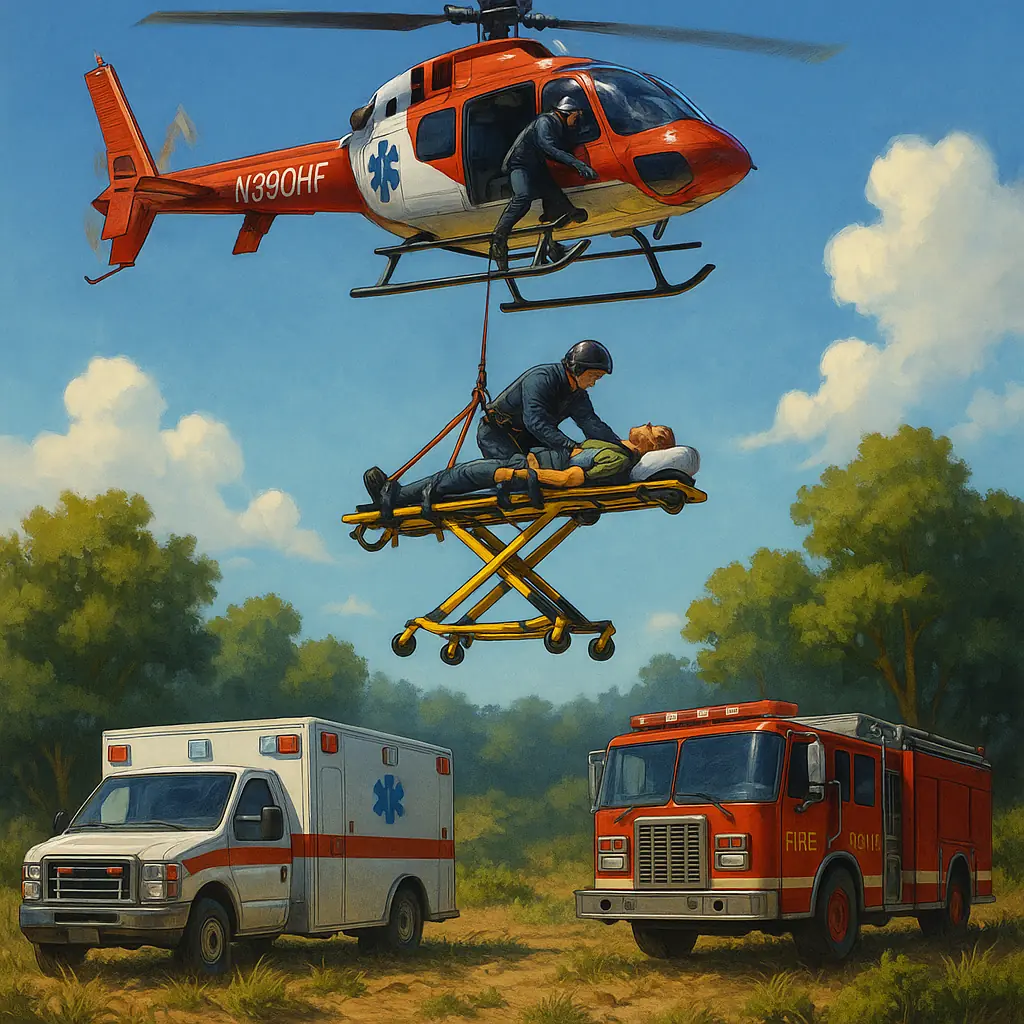
- Where available, helicopters and small aircraft perform urgent evacuations, but capacity is tiny compared with road networks.
- Local volunteers and community first-aiders become the first line of response while official services triage resource allocation.
Patchwork systems and local resilience
Emergency services adopt temporary but effective workarounds. Municipalities prioritize mobility solutions that don't need paved roads.
- Rapid expansion of all-terrain vehicles (ATVs), tracked vehicles and modular stretchers that can be carried over rough ground.
- Drones deliver defibrillators, bleeding-control kits and communications gear to isolated victims.
- Communities create neighborhood medic hubs—small clinics and staffed first-responder teams within walking distance.
- Firefighting emphasizes localized crews, fuel breaks, and water caches; large-scale suppression becomes more reliant on air assets.
System redesign and distributed services
With the novelty worn off, cities and regions redesign emergency systems around non-road transport modes and decentralization.
- Hospitals and emergency departments decentralize into satellite clinics and urgent-care nodes to reduce transport needs.
- River and canal networks receive heavy investment for patient and supply movement where geography allows.
- Dedicated aerial corridors and vertiports for medevac helicopters and larger lift drones are regulated and expanded.
- Telemedicine becomes routine; remote triage reduces unnecessary physical transfers.
A different urban fabric
Society reshapes itself around the constraints and opportunities of a roadless world.
- Settlement patterns densify around water, rail, or airfields, and critical services are distributed to minimize travel times on difficult terrain.
- Urban design emphasizes pedestrian corridors, cargo canals, and rail-first logistics. Emergency-response architecture—watchtowers, drop-points, community clinics—becomes integrated into neighborhoods.
- Ecosystems often recover where roads would have fragmented habitats; however, new infrastructure such as air corridors and canals introduces different ecological effects.
What science says
Travel speed and capacity are the core physical constraints that roads solve. On paved roads a wheeled vehicle converts engine power into fast, efficient movement; off-road, rolling resistance and terrain obstacles drastically cut achievable speeds and increase energy costs.
Key mechanisms at play:
- Mobility trade-offs: Boats and trains carry heavy loads efficiently but follow fixed routes; helicopters and VTOL craft are flexible but limited by range, weather sensitivity, and high fuel use.
- Drones and robots: Small unmanned systems excel at delivering lightweight, high-value items (AEDs, medicines, sensors). Their physics—battery energy density, lift-to-weight ratios, and payload limits—mean they complement but cannot replace human transport for many casualties.
- Medical throughput: Hospitals' ability to treat patients becomes the bottleneck. Faster transport matters less than flattening demand spikes through local care, telemedicine, and preventive public health.
- Information flow: Rapid situational awareness via sensors, mesh communications and civilian reporting becomes critical when physical movement is slow. Coordinated triage relies on data more than speed alone.
Likely vs speculative outcomes: it's likely that travel times would increase initially and that small unmanned vehicles and decentralized care would scale up. Speculative outcomes include large shifts to permanent aerial transit for urban cores or wholesale reorientation to waterways—both depend heavily on geography, technology costs, and political will.
Could anything survive?
Communities and emergency planners would adopt layered strategies to keep people alive and well when roads are absent.
Practical measures for households:
- Learn basic first aid and bleed-control; maintain a well-stocked emergency kit and a portable stretcher.
- Identify nearest community clinic, water access point and vertical take-off landing (VTOL) pad.
- Establish neighborhood communication plans using radio or mesh-network apps for situations when cellular networks falter.
Municipal actions:
- Create distributed micro-clinics and training programs so help is within walking distance for most residents.
- Invest in multimodal fleets—boats, tracked rescue rigs, utility aircraft and cargo drones—matched to local terrain.
- Preplace supply caches (water, fire suppression gear, medicines) and implement water/fire breaks in wildfire-prone zones.
- Designate and protect aerial corridors and landing zones for medevac; regulate noise and environmental impacts.
Policies and long-term planning:
- Adopt land-use rules that reduce long-distance travel for essential services: schools, clinics, and markets spread evenly.
- Prioritize telehealth broadband and resilient power at local clinics.
- Develop mutual aid networks between neighboring towns that use rail, river or air links for heavy lifts.
Trade-offs and caveats: air assets are life-saving but expensive and weather-limited; drones scale for small payloads but cannot extract many patients. Investing in human capital—training volunteers and decentralizing care—will usually give the biggest survival returns for the least money.