Survival meter
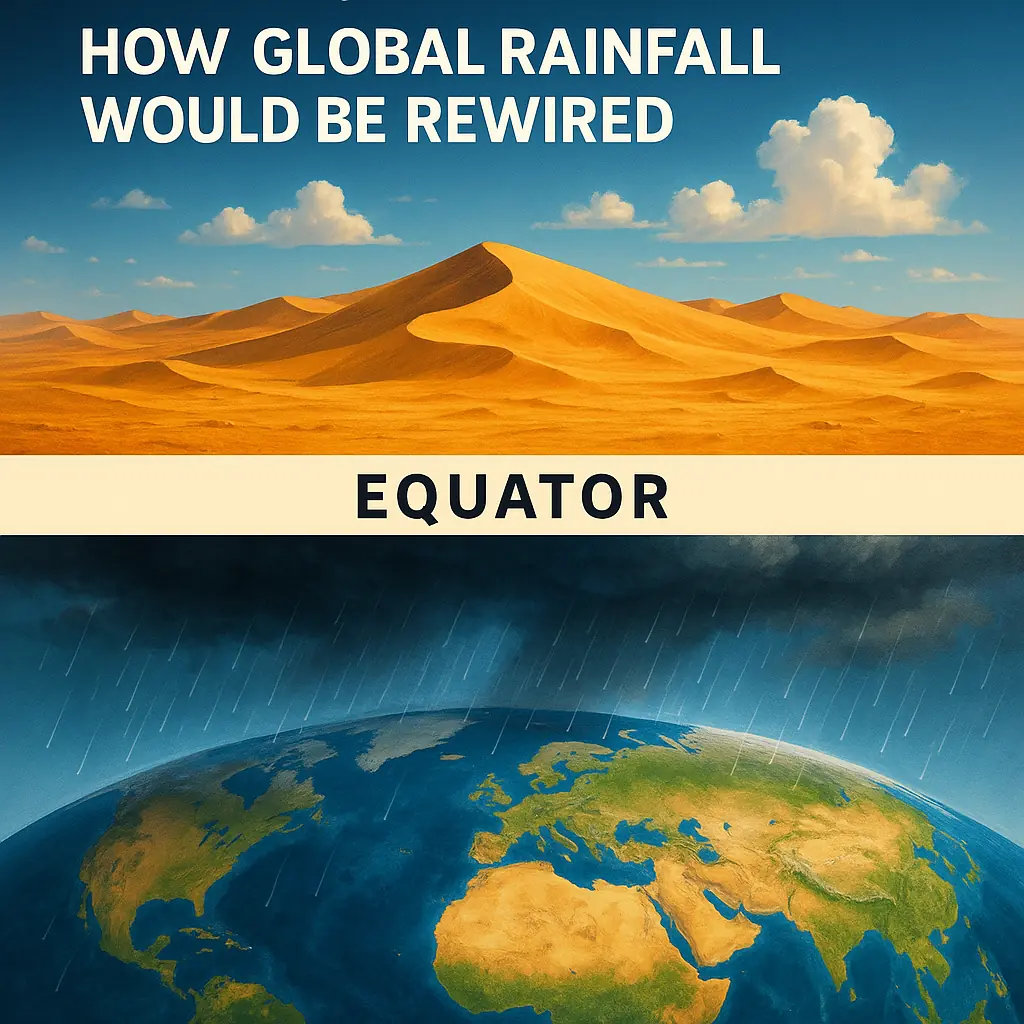
Move the Sahara to the Earth’s equator and you do more than swap sand for sun: you relocate one of the planet’s largest thermal and radiative players into the engine room of atmospheric circulation. The result is a wholesale reconfiguration of where, when and how much rain falls—locally and in regions thousands of kilometers away.
This scenario traces the immediate atmospheric response, the seasonal and multi‑decadal feedbacks, and the likely winners and losers for people and ecosystems.
Timeline of consequences
Instant atmospheric rebalancing
Placing a wide, hot, bright desert on the equator forces near‑surface air to heat more strongly over land than ocean. Expect:
- A pronounced thermal low over the new desert that draws moist air from nearby oceans.
- An initial intensification and anchoring of the Intertropical Convergence Zone (ITCZ) over the desert during its daylight hours.
- Shifts in upper‑level winds and Rossby wave patterns that can produce anomalous weather far away—altered storm tracks across the Atlantic and subtropical jet undulations.
Seasonal monsoons reorganize
Seasonal land heating will become a dominant organizer of rainfall. Key changes:
- A stronger, possibly year‑round convective belt above the equatorial Sahara that generates heavy afternoon storms and a new regional monsoon cycle.
- Displacement of the ocean‑anchored ITCZ and changes to the West African and South Asian monsoons because the thermal contrast between the moved landmass and adjacent seas reshapes inflow patterns.
- Immediate reduction in Saharan dust lofting to its old downwind targets (the eastern Atlantic and Amazon), altering cloud microphysics and nutrient deposition.
Surface feedbacks and vegetation shifts
Over multiple years the surface responds to the new rainfall regime and altered dust and albedo patterns. Probable developments:
- If rainfall becomes sustained, colonization by grasses, shrubs and eventually forest in some locations will lower surface albedo and increase soil moisture—strengthening local rainfall via evapotranspiration.
- If rains are episodic and soils remain poor, the area could stay a seasonally flooded savanna, intermittently sending strong moisture pulses into the atmosphere.
- Downwind ecosystems—Amazon, Sahel, Mediterranean—react to changed dust fertilization and humidity, shifting productivity and seasonal rains.
New climate equilibria and ocean response
On long timescales the atmosphere–ocean system seeks a new balance. Expect:
- Altered tropical convection patterns that can change global teleconnections (ENSO modulation, Atlantic variability).
- Potential drift of subtropical dry zones as the Hadley circulation reconfigures; some midlatitude storm tracks migrate.
- Slow changes to ocean circulation from altered heat and freshwater fluxes; impacts on regional fisheries and upwelling systems are plausible but uncertain.
What science says
Rainfall placement is governed by where air rises and cools. The equator is special because solar heating there normally establishes the ITCZ—a belt of persistent ascent. By relocating a vast, high‑insolation land surface to the equator we create a strong thermal contrast against neighboring oceans. Land heats faster than water, so daytime convection intensifies.
Several interacting mechanisms matter:
- Thermal forcing and the ITCZ: A hot equatorial landmass acts like a magnetic center for the ITCZ, anchoring convective rainfall over the continent and changing its seasonal migration.
- Hadley cell adjustment: The Hadley circulation responds to equatorial heating by altering the latitude where air descends, potentially shifting subtropical dry belts.
- Albedo and vegetation feedbacks: Bare sand reflects much sunlight—if vegetation establishes, lowered albedo amplifies heating and moisture recycling, promoting more rain in a positive feedback.
- Dust and aerosol effects: The Sahara today lofts huge quantities of mineral dust that fertilize oceans and forests and modify cloud properties. Moving that dust source changes aerosol distributions, with knock‑on effects on cloud formation and precipitation efficiency far away.
- Ocean–atmosphere coupling: Changes in surface heat and fresh water fluxes can nudge ocean currents and SST patterns, which feed back on atmospheric circulation and rainfall.
Which outcomes are likely versus speculative?
- Likely: Increased local convective rainfall over the new equatorial land, major reorganization of the regional monsoon, and rapid reduction in downwind dust transport.
- Speculative: Full transformation into tropical rainforest everywhere the desert sits; large‑scale shutdowns of remote ocean circulations. These depend on long‑term soil development, vegetation colonization, and oceanic responses that have large uncertainties.
Could anything survive?
The human and ecological consequences would be profound but heterogeneous. People would not go extinct; many livelihoods would be disrupted and new opportunities would arise.
Immediate hazards:
- Flash floods and infrastructure collapse where heavy convective rain falls on terrains unprepared for it.
- Disease vectors (malaria, dengue) expanding into newly wet zones.
- Disruption of agriculture in regions currently relying on predictable monsoons or Atlantic moisture inflow.
Medium‑term adaptations and opportunities:
- New arable zones could open if soils and rainfall stabilize—irrigation and agroforestry could produce yields rivaling present tropical agriculture.
- Reduced Saharan dust deposition downwind might harm some ecosystems (e.g., Amazon fertility) but improve air quality locally and reduce respiratory disease from dust.
- Human migration pressures will rework population centers; coastal and riverine infrastructure must adapt to shifted rainfall and flood risk.
Practical survival guidance:
- Invest in flood‑resistant infrastructure and early warning systems.
- Prioritize public health measures in newly humid zones: mosquito control, vaccination, and sanitation.
- Encourage diversified agriculture and soil restoration—fast transition from emergency relief to planned land management will determine whether the region becomes productive or stays degraded.