Survival meter
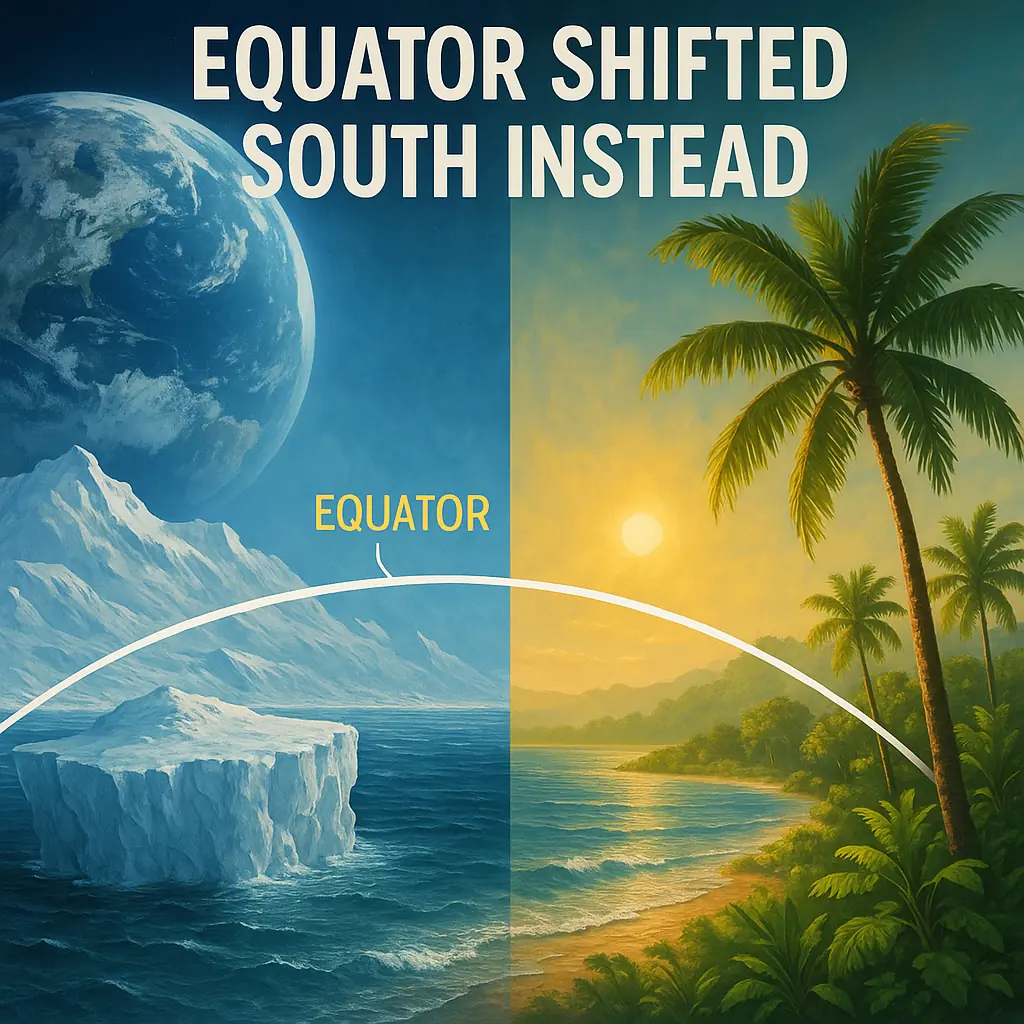
Imagine the planet waking up with its waistline a few hundred kilometers south. Cities that once wallowed in perpetual sun find themselves edging toward seasonal monsoons or dry spells. Forests that thrived under a steady tropical climate begin to falter. The equator is not a decorative line. It organizes wind belts, rainfall, ocean gyres and where the sun drills its highest angles each year. Move it, and you move climate, crops and coastlines.
There are believable ways the geographic equator could migrate: slow mantle sloshing, massive ice redistribution, or, far less likely, a giant impact. The pace matters. A gradual slide over centuries is disruptive but survivable. A sudden flip in decades would be violent and messy. Below I run through how such a southward shift would play out, the physics behind it, and what humans would have to do to survive.
Timeline of consequences
Water and waves catch up first
If the axis reoriented quickly, centrifugal bulge and the oceans would attempt to follow the new equator. Water would slosh toward the new midline, producing regional sea-level rises and massive tsunamis near some coasts. The pattern would be uneven; some shorelines would gain a meter or more in hours, others would drop.
Power grids, ports and low-lying cities would be at acute risk. Atmospheric circulation would not change overnight, but shock winds and altered storm tracks could appear as the atmosphere responded to a new rotational equilibrium.
Rain belts migrate, deserts and deluges appear
The Intertropical Convergence Zone, where trade winds meet and rain concentrates, tends to ride near the thermal equator. If that thermal belt moves south with the geographic equator, regions just south of the old equator gain wet season intensity while some northern tropical zones dry out. Monsoon systems reconfigure; agricultural calendars get thrown off.
Crops that depended on predictable rains will fail in many places for several seasons. Humanitarian crises and migrations would follow in the most vulnerable regions.
Oceans, currents and ice come into balance
Ocean gyres and major currents respond slowly. A shifted equator changes trade wind patterns and the position of upwelling zones. Fisheries can collapse in some areas and boom in others. Southern-hemisphere currents would gain influence in places that used to be northern-featured.
Ice sheets react over decades to centuries. If the shift places more solar energy over southern high latitudes, Antarctic edge melting could accelerate, feeding sea-level rise while the Arctic adjusts in the opposite sense. The global sea-level budget will be complex and regionally variable.
Ecosystems migrate or die, human systems adapt
Species will track climate bands toward the new tropics or fail if they can’t move. Rainforests could slowly migrate south where conditions permit. Deserts could expand in zones that lost monsoonal intake. Long-lived changes to soil moisture and fire regimes reshape landscapes.
Human adaptation would take the form of relocated agriculture, revised coastal planning, and new infrastructure. Cultural disruption and economic cost would be high, but over centuries a new equilibrium would settle in place.
What science says
How do we move the equator? Strictly speaking, the equator is where Earth's rotational plane cuts the surface. Move the rotation axis relative to the crust and the equator moves with it. Scientists call this true polar wander when the solid Earth reorients relative to the spin axis. Small shifts happen as mass moves around on Earth. Large, rapid shifts are rare and demand enormous mass redistribution, such as a major asteroid impact, catastrophic ice-sheet collapse, or massive mantle flow anomalies.
A degree of latitude equals about 111 kilometers on the ground. A 5 degree southward shift would push the equator roughly 555 kilometers toward the southern hemisphere across all longitudes. That is enough to move many populous regions in and out of tropical rainfall belts.
Climate responds because energy input and atmospheric circulation patterns are latitude-dependent. The Hadley circulation, which governs trade winds and the subtropical dry zones, centers on the thermal equator. If the thermal equator follows the geographic equator, the zones of rising moist air migrate with it. Ocean dynamics matter too. The equatorial current systems and upwelling zones are wind-driven, so they change when the wind field does. Finally, rotational changes alter the centrifugal potential and the geoid, so sea surface heights change regionally even without melting ice.
Magnitude and timing are everything. A slow slide of a few tenths of a degree per century invites adaptation. A jump of several degrees in a decade packs far more acute hazard: tsunamis, abrupt crop failures and rapid ecosystem stress.
Could anything survive?
Survive and adapt by planning for shifting rainfall and relocated coasts. If the change is slow, governments and communities can move agriculture belts, shift irrigation focus and breed crops for new rainfall windows. If the change is fast, immediate priorities are evacuation from tsunami-prone coasts, temporary water and food relief, and stabilization of electricity and transport hubs.
Practical measures:
- Map exposure. Use models to translate any proposed axis change into regional sea-level and precipitation shifts so you know which areas will gain or lose water.
- Protect seed and genetic diversity. Seed banks and living collections increase the odds of finding varieties suited to new climates.
- Prioritize flexible agriculture. Mobile livestock systems, drought-tolerant crops, and irrigation that can be redirected matter more than specialty monocultures.
- Invest in coastal defenses and managed retreat. Some shorelines will need seawalls or planned abandonment.
- Support ecosystem corridors. Help species move by protecting north-south habitat linkages, especially across mountain ranges.
The social side is as important as the technical. Predictable, well-funded migration programs and international coordination reduce conflict. Rapid changes strain institutions. With smart planning most human communities can survive; many ecosystems will not.