Survival meter
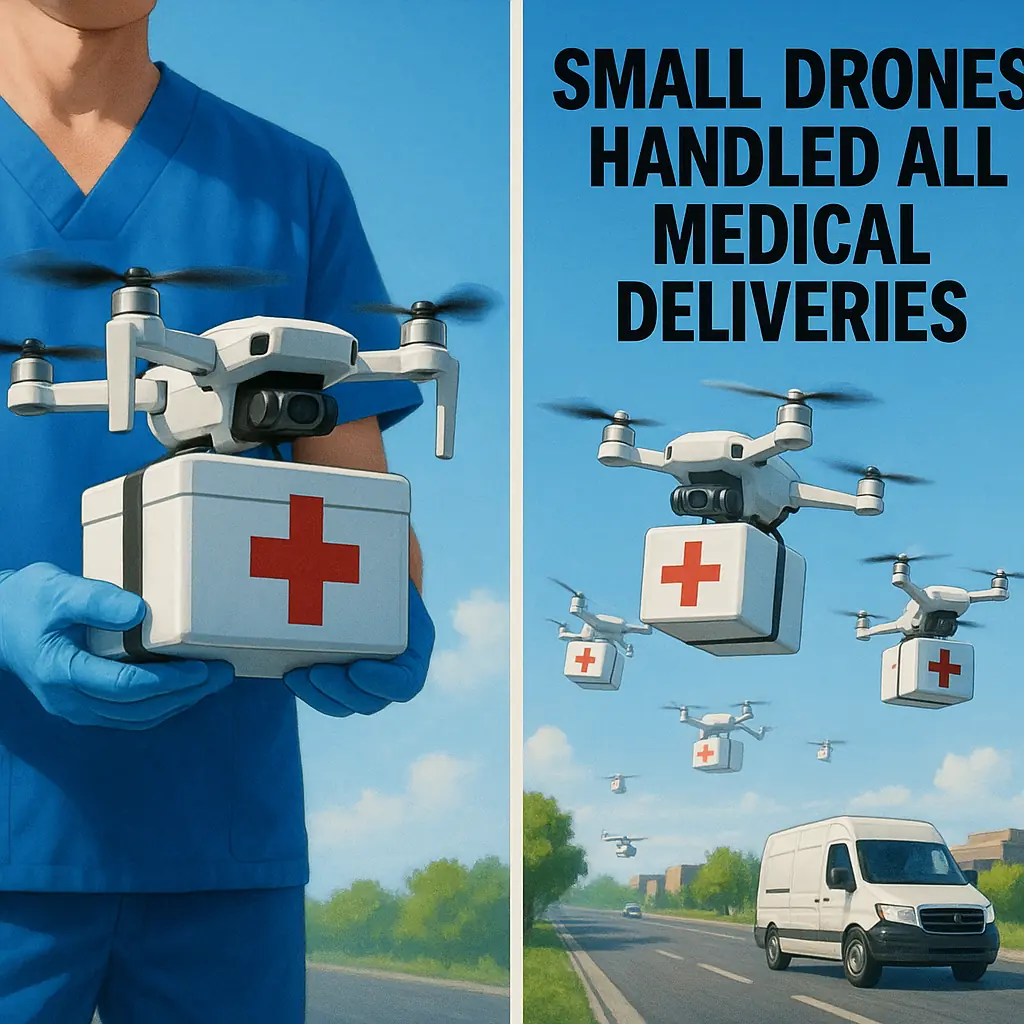
Imagine a world where every syringe, bandage, test kit and vial of vaccine arrives by small flying robot. Not a single road trip, not one traffic delay. Sounds like a sci-fi convenience. It's closer than you think.
We run through how a tiny, buzzing logistics layer could change healthcare, what can go right, what can go wrong, and what to do if your city decides to trust the sky with people's lives.
Timeline of consequences
Proof of concept and local pilots
Hospitals and startups run short-range trials. Pharmacies use drones for urgent items: blood samples, emergency meds, point-of-care tests. Trials focus on line-of-sight flights, lightweight payloads, and simple drop-offs. Regulators grant temporary waivers for beyond-visual-line-of-sight flights in limited corridors.
Urban rollout and regulatory frameworks
Major cities approve structured low-altitude routes and dedicated skyways above industrial zones. Hospitals connect to microhubs on rooftops and parking lots. Logistics platforms coordinate hundreds of drones with traffic management software. Noise, privacy and safety complaints trigger stricter certification for operators and airframes.
Rural reach and cold-chain improvements
Battery and insulation tech advance. Remote clinics receive vaccines and lab reagents within hours instead of days. Small drones prove lifesaving for obstetric emergencies and organ couriering in sparsely populated regions. Community health workers become regular drone operators or hub managers.
Scaling and supply-chain integration
Major health systems integrate drone lanes into broader logistics. Inventory systems, electronic health records and automated dispatch are married to aerial fleets. Drones take most last-mile legs while trucks or trains handle bulk movement. Costs per delivery fall, making frequent restocking possible.
Failure modes and public pushback
Several high-profile incidents surface: a swarm collision in a storm, thefts at rural landing pads, and a ransomware attack that ground regional fleets. Public trust fractures. Cities demand stricter audit trails, tamper-resistant containers, and mandatory redundancy for high-stakes items like blood and organs.
A mature, mixed-delivery ecosystem
By mid-century drones become the default for urgent, lightweight medical deliveries. Ground vehicles still carry bulk supplies and heavy equipment. Legal frameworks, standardized hardware and resilient software cut failure rates. The system is resilient but not infallible; contingency plans remain a permanent part of hospital logistics.
What science says
Small medical drones fall into a handful of technical types: quadcopters and multirotors for vertical takeoff and precise drops, small fixed-wing craft for longer range, and hybrid designs that promise both. Payloads are modest. Most deliveries are under 5 kilograms, which covers blood units, lab kits, vaccines in insulated carriers, and small imaging parts.
Key enabling tech:
- Autonomy and routing. Real-time fleet management handles thousands of missions, prioritizing urgency, battery state, weather, and airspace constraints.
- Sense-and-avoid systems. Cameras, radar and lidar keep drones from colliding with buildings, birds and each other. Redundancy in sensors is standard for medical cargo.
- Cold-chain modules. Lightweight passive insulation plus active microcoolers keep temperature-sensitive meds within strict ranges for hours.
- Secure containers. Tamper-evident locks and telemetry report temperature, shock and opening events.
- Communications. Cellular, satellite and mesh networks provide command links and encrypted telemetry.
Benefits are straightforward. Speed saves lives. Shorter delivery times for blood, antivenom, or emergency meds reduce loss and expand reach into isolated areas. Economies of scale can lower per-delivery cost once air traffic rules and routing algorithms mature.
Hard limits remain. Weather reduces availability. Heavy or bulky supplies still need trucks. Energy density of batteries constrains range and payload. Urban noise and visual pollution become social problems once fleets scale. Security risks include physical theft, GPS spoofing and cyberattacks on flight controllers or dispatch systems.
Could anything survive?
Preparing for a world where small drones handle most medical deliveries means thinking in layers: redundancy, verification, and local capability.
For individuals
- Keep local supplies for predictable needs. If you rely on daily meds, store a short backup supply in a cool, safe spot in case a regional fleet halts.
- Learn simple cold-chain basics. If you get vaccine deliveries at home, check seals and temperature readouts, and refuse obviously warm packages.
- Know alternatives. Keep contact info for nearby clinics, community health workers, and the regional hospital's conventional delivery service.
For clinics and hospitals
- Run dual-path logistics for critical items. If a drone fails, have a ground courier or neighboring hospital on standby.
- Insist on telemetry and audit logs. Know who signed for a delivery, when temperature deviated, and where a container was last tracked.
- Invest in tamper-resistant landing pads and simple anti-theft measures at rural hubs.
For regulators and cities
- Create enforceable safety standards for medical payloads, including mandatory redundancy for organs, blood and emergency meds.
- Designate quiet corridors and landing zones to minimize noise and privacy intrusions.
- Mandate open reporting for incidents and near-misses to speed learning and reduce repetition of failures.
What to expect if something goes wrong. Likely immediate effects are localized: service interruptions, delayed lab results, and isolated clinical impact. Large-scale collapse is unlikely, but coordinated cyberattacks or cascading weather events could knock out fleets regionally. Resilience requires the old systems to stay partly alive.