Survival meter
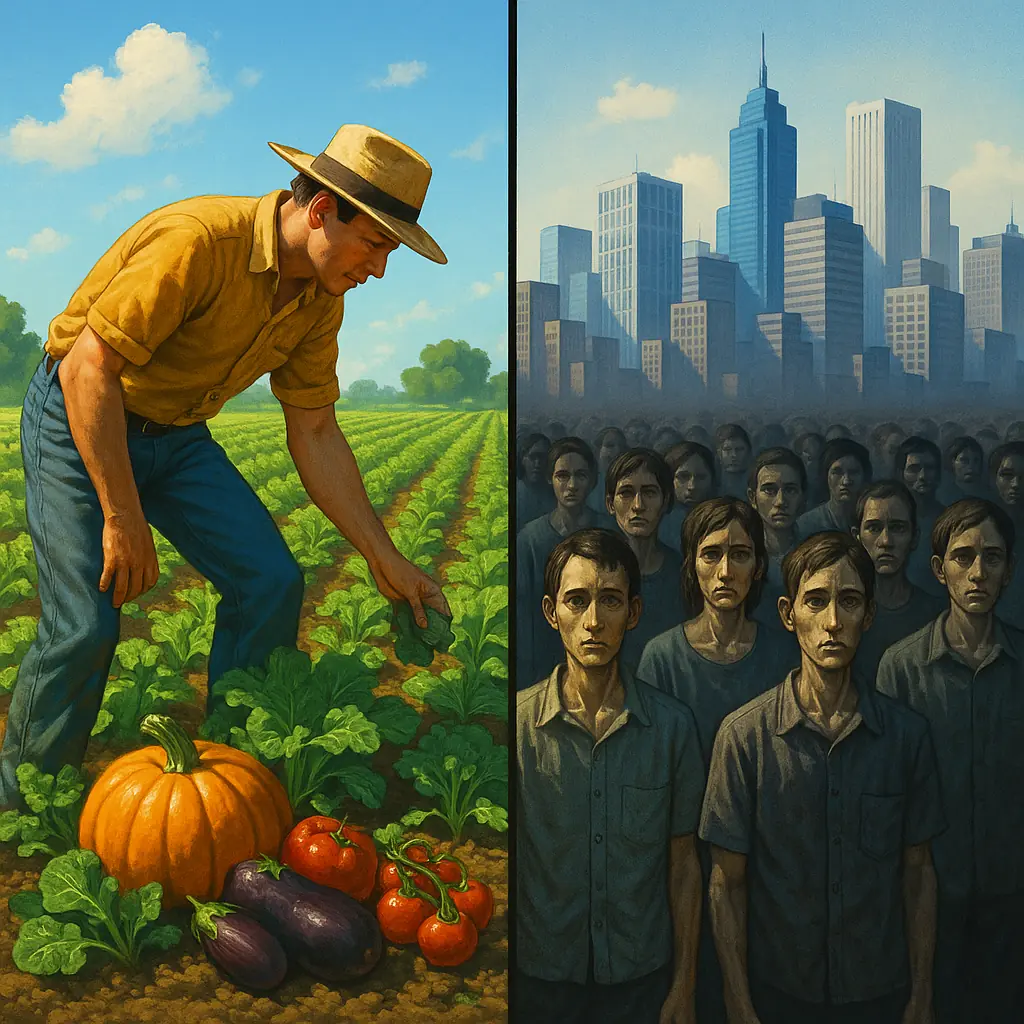
Cities today import most of their food. Long supply chains, concentrated processing, and cheap fossil-fuel transport make that possible. Imagine those links fraying or breaking and local farms suddenly having to shoulder the entire burden of feeding urban millions.
The math is simple and stubborn. Urban diets need calories, protein, and variety. Land, labor, water, and storage matter. Some parts of the menu are easy to grow nearby. Others are not. The answer is not a single yes or no. It is a patchwork of tradeoffs, emergencies, and policy choices.
Timeline of consequences
Panic buying, targeted shortages, and quick fixes
Shelves empty first for fresh produce and perishable dairy. Urban residents scramble for what they can store. Small farmers near cities get swamped by demand but lack the logistics to redirect produce fast enough. Community gardens and allotments see a surge in interest, but they supply little more than herbs, lettuce, and a few root vegetables.
Emergency measures appear: restaurants selling surplus, local markets extending hours, and volunteers converting public plots into quick-turn vegetable beds. Calories stay scarce where staple grains and oils are missing.
Reconfiguration and rationing
Municipalities impose limits and prioritize high-need neighborhoods. Food hubs form to collect, package, and distribute local harvests. Peri-urban farms shift to crops with high caloric or protein yield per hectare, like potatoes, legumes, and some grains. Urban farms expand rooftop and hydroponic setups where electricity remains available.
Supply is uneven. Fresh leafy greens roll out to some districts, while staples still rely on relief shipments or stored reserves. Nutritional gaps begin to show among vulnerable groups.
Scaling local production and changing diets
Local agriculture scales up but hits hard limits. Labor-intensive vegetable production can expand quickly. Converting parks, golf courses, and vacant lots to market gardens adds acreage, but yields per hectare vary. Cities adopt tighter dietary guidance: more beans and root crops, less beef and imported fruit.
Investment flows to cold storage, bulk grain silos, and small-scale milling. Vertical farms multiply where capital and power permit. Where energy is scarce, people rely on low-tech storage and preservation: drying, pickling, and fermentation.
Partial independence, persistent gaps
Many cities reach partial food independence. Peri-urban belts supply a significant share of vegetables, eggs, and some dairy. But land constraints, especially for dense megacities, limit cereal and oilseed production. Urban diets stabilize at lower meat and calorie intake compared with previous decades.
Social changes stick. Local food systems decentralize logistics, and a cultural shift toward seasonal menus becomes permanent. Areas with arable hinterlands thrive. Coastal and landlocked megacities without nearby fertile land struggle comparatively.
When local farming is not enough
The scenario fails where population density outruns usable land and political will is weak. Inequities widen. Wealthier residents secure fresh food through private contracts, while poorer communities subsist on staples or aid. Urban malnutrition rises in some neighborhoods, prompting migration pressures and social strain.
Infrastructure collapse, like persistent power outages, undermines high-tech urban farms and cold chains. Those losses expose how dependent cities remain on regional and global systems for bulk calories and industrial inputs like fertilizer and seed.
What science says
Feeding a city from nearby farms is a problem of quantities and types. An average adult needs roughly 2,000 to 2,500 kilocalories per day. For a city of 1 million, that is 2 to 2.5 billion kilocalories every day. Calories convert into land differently depending on crops. Potatoes produce about 7 to 10 times more calories per hectare than wheat. Pulses give protein efficiently. Oilseeds and sugar crops take space and specific climates.
Peri-urban land can supply a lot of high-value, nutrient-dense food like vegetables, fruit, eggs, and some dairy. But cereals and oil crops, which provide the bulk of calories in most diets, require large contiguous areas. Urban and peri-urban belts rarely have enough area to match demand for those staples.
Technology shifts the balance but does not erase physics. Vertical farms and hydroponics can produce vegetable mass per square meter far above field yields, but they need significant capital, continuous energy, and inputs like nutrient solutions. Aeroponics and controlled-environment agriculture shine for leafy greens and herbs. They struggle with calorie-heavy staples and are expensive to scale for mass feeding.
Labor and logistics matter as much as biology. Harvest windows for perishable crops require fast distribution and cold chains. Small farms need aggregation points and processing to feed cities at scale. Fertilizer and seed supplies, often produced at industrial scale, are single points of failure. Soil health and water availability limit how intensively land can be farmed over the long term.
Finally, diets change. To make local farming viable, cities must accept lower meat consumption, more seasonal and preserved foods, and higher reliance on legumes and tubers. Those shifts improve land efficiency but demand cultural adjustment and policy nudges.
Could anything survive?
If you want to cope while local farming is the backbone of urban food, focus on calories, preservation, and local networks.
- Grow high-return crops. Potatoes, sweet potatoes, beans, and squash give the most calories and nutrition per plot. Herbs and salad greens supplement diets but do not replace staples.
- Use space ruthlessly. Rooftops, balconies, parks, schoolyards, and roadside verges can become productive. Intensive methods like raised beds and succession planting boost output.
- Preserve aggressively. Learn canning, fermenting, drying, and root-cellaring. Bulk preservation smooths seasonal swings and reduces spoilage.
- Organize locally. Form or join food hubs for shared storage, milling, and distribution. Cooperatives let small farms pool resources and stabilize supply.
- Shift diet where needed. Swap animal protein for beans, lentils, and legumes. Use grains sparingly and favor calorie-dense tubers when cereals are scarce.
- Push for policy. Municipal incentives for greenhouses, urban allotments, and water reuse accelerate scale-up. Support for low-cost storage and local processing yields big gains.
Short-term survival is possible with community action and simple tech. Long-term resilience requires land use planning, investment in storage and processing, and social equity measures so that access does not depend on income.