Survival meter
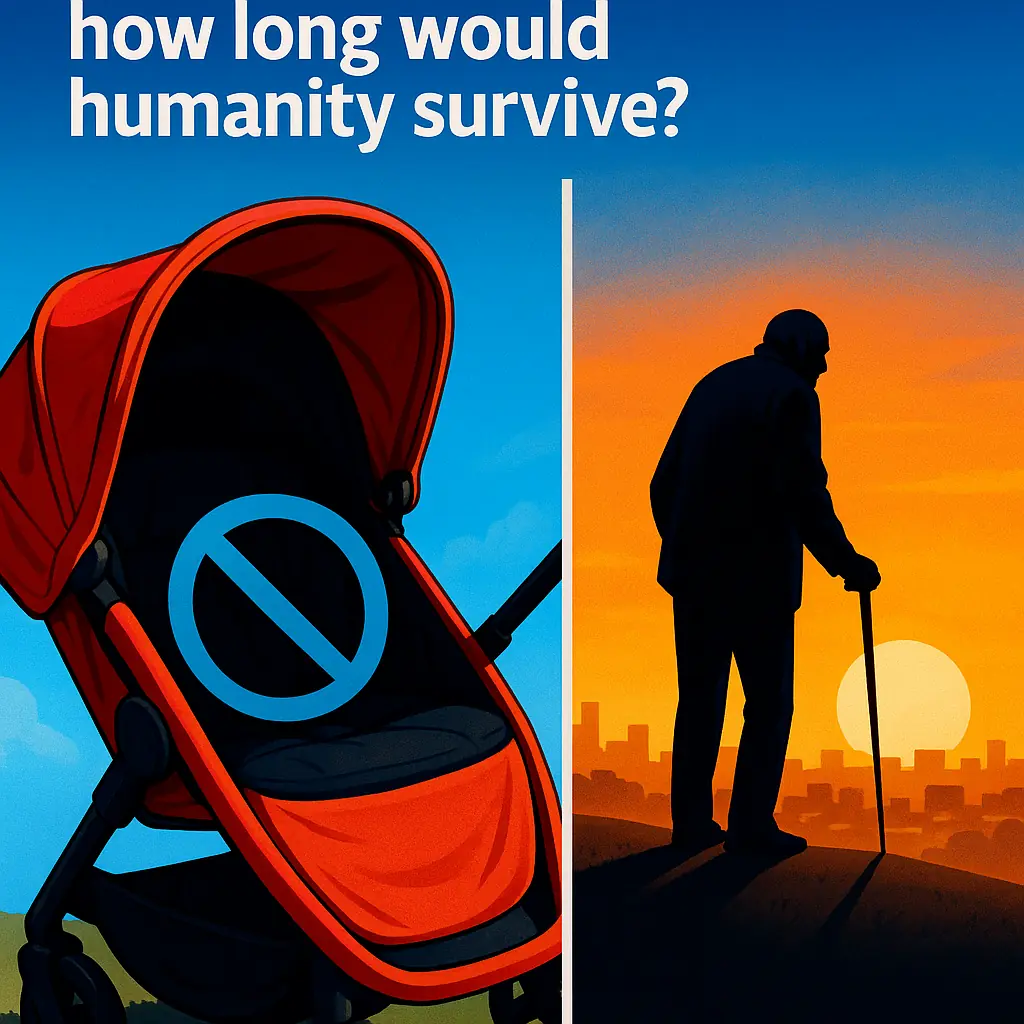
Imagine a planet where the birth rate instantaneously drops to zero. No new infants arrive. Pregnancies stop, and the youngest people are those alive at the moment the change happens. At first the shock would be social and political. Over decades it would become biological and demographic. Eventually it would be existential.
Demography gives a blunt answer: without births, a population ages and then disappears. The details of how society unravels, which systems collapse fastest, and what the natural world does in response are more interesting. This scenario walks through the timeline, the science, and what you would do if you woke up in a world with no new children.
Timeline of consequences
Immediate shock, emergency response
Hospitals and maternity wards switch from routine births to crisis management. Governments scramble to explain the biological cause. Fertility clinics, religious leaders, and politicians become focal points for desperate hope and conspiracy. Markets twitch as investors price long-term demand changes, but daily life mostly continues: workplaces, schools, and services still operate, because current children and adults remain.
Short-term shortages are more likely in sectors that rely on very young workers, such as childcare, but automation and older workers can temporarily fill many roles. The biggest immediate stress will be psychological: grief, panic, and political unrest as people confront a future with no new generation.
Aging population and rising dependency
The population pyramid inverts. Fewer working-age people support more retirees. Pensions and pay-as-you-go social systems start to fail in many countries within a decade. Schools lose students; teacher jobs vanish. Industries with long training pipelines, like medicine and engineering, begin to experience shortages as replacements retire.
Economies slow. Productivity falls and innovation rates dip because younger cohorts are often the most flexible adopters of new ideas. Some automation accelerates to fill labor gaps, while other services that require human care, like many aspects of eldercare, strain under rising demand.
Systemic decay, knowledge risk
Infrastructure maintenance becomes a chronic problem. Power plants, bridges, and digital networks need constant skilled attention. With fewer apprentices and fewer young technicians, the risk of cascading failures grows. Supply chains shorten. Cities shrink as retirees leave high-cost areas for simpler, lower-maintenance locales.
Cultural transmission weakens. Universities and research institutions shrink or close. Libraries and archives may be preserved by dedicated groups, but hands-on artisanal skills and localized knowledge risk being lost when older practitioners die without passing them on to a younger generation.
Population collapse and last generations
Global population plummets toward zero as the last birth cohorts age out. Medical systems, once overwhelmed by eldercare, now lose critical mass and become patchwork services. Some technologically advanced communities might maintain high standards of living for a few more decades, but they are isolated islands.
The final generations would confront profound social issues: how to allocate dwindling resources, whether to preserve cultural memory, and how to maintain critical systems like nuclear safeguards. Extinction becomes a logistical countdown rather than an abstract risk.
Extinction and a quieter planet
Absent a reversal, the last human dies within about 120 to 150 years of the zero-birth event. Longevity trends and exceptional individuals might stretch the timeline slightly, but not indefinitely. After humanity disappears, the planet continues. Cities decay, forests reclaim farmland, and many domesticated species decline without human care.
Some technologies and artifacts could survive for centuries or longer, but they will degrade without maintenance. Biological and ecological recovery begins on a new trajectory, shaped by the legacy of climate change, pollution, and introduced species.
What science says
Demography is arithmetic. If births stop, the only variable is how long living people survive. The average life expectancy does not increase just because there are no children. Mortality from age-related diseases, accidents, and illness keeps ticking. Maximum human lifespan puts a hard ceiling: just a handful of people have lived past 110 years. That sets an upper bound on how long people as a species can stick around without reproduction.
Economics and social systems amplify the biological decline. Modern states depend on a flow of young workers to pay for pensions and to staff hospitals, farms, and factories. When that flow stops, the systems designed for continual replacement falter. Technology can delay failure in some domains. Automation, robotics, and remote monitoring can maintain critical infrastructure for a while. But many tasks require tacit knowledge that is normally passed person to person across generations.
Ecologically, the immediate effect of fewer humans is a reduction in direct pressures: less land conversion, lower fossil fuel consumption, and fewer nutrient inputs from agriculture. Over decades, many ecosystems would recover. However, climate inertia and accumulated pollution mean recovery will be imperfect and uneven. Some domesticated species would decline rapidly without care. Pathogens that specialize on humans would also fade, while zoonotic patterns could change as humans retreat from landscapes.
Speculative technologies might change the outcome. Stored gametes or embryos could, in theory, restart reproduction if political will exists, but the scenario assumes no new children at any point. Even if lab-grown gametes or cloning became feasible, maintaining genetic diversity and social frameworks for raising children would present massive challenges. So the likely end point remains demographic extinction, though the precise timing depends on survival improvements and societal resilience.
Could anything survive?
If you find yourself alive in a world where no new children are being born, the practical question is not how to prevent extinction, because the demographic clock is unforgiving. The relevant questions are how to extend quality of life, preserve knowledge, and keep essential systems running as long as possible.
Immediate actions for individuals and communities:
- Form durable local networks. Shared meals, caregiving, and mutual labor will reduce strain and maintain morale.
- Learn practical trades now. Plumbing, electrical work, engine repair, small-scale agriculture, and mechanical skills matter enormously. Pass those skills laterally and document them clearly.
- Secure redundant energy and food systems. Small modular renewables, stored fuel, community greenhouses, seed banks, and soil-care practices will be lifesavers.
- Preserve knowledge aggressively. Digitize books and manuals, but also train people in hands-on replication of critical tools. Keep multiple physical and digital backups in different locations.
- Prioritize mental health and purpose. A world without a next generation changes meaning for many. Community rituals, deliberate storytelling, and projects that span decades or centuries can give life structure.
For institutions: focus on triage. Keep nuclear sites, major dams, and disease-control labs safe. Create cross-generational apprenticeship programs to transfer tacit knowledge now. Invest in modular technologies that require minimal specialized labor to maintain.
None of these steps reverses the demographic trend. They do, however, increase the duration and quality of human presence on the planet while leaving behind better odds that artifacts and knowledge survive for as long as possible.