Survival meter
Bananas are everywhere. They live in school lunches, supermarket displays, and the economies of small tropical nations. Most of the fruit we eat is the Cavendish, a single genetic clone propagated by cuttings. That uniformity is a strength for supermarket supply chains and a weakness against disease.
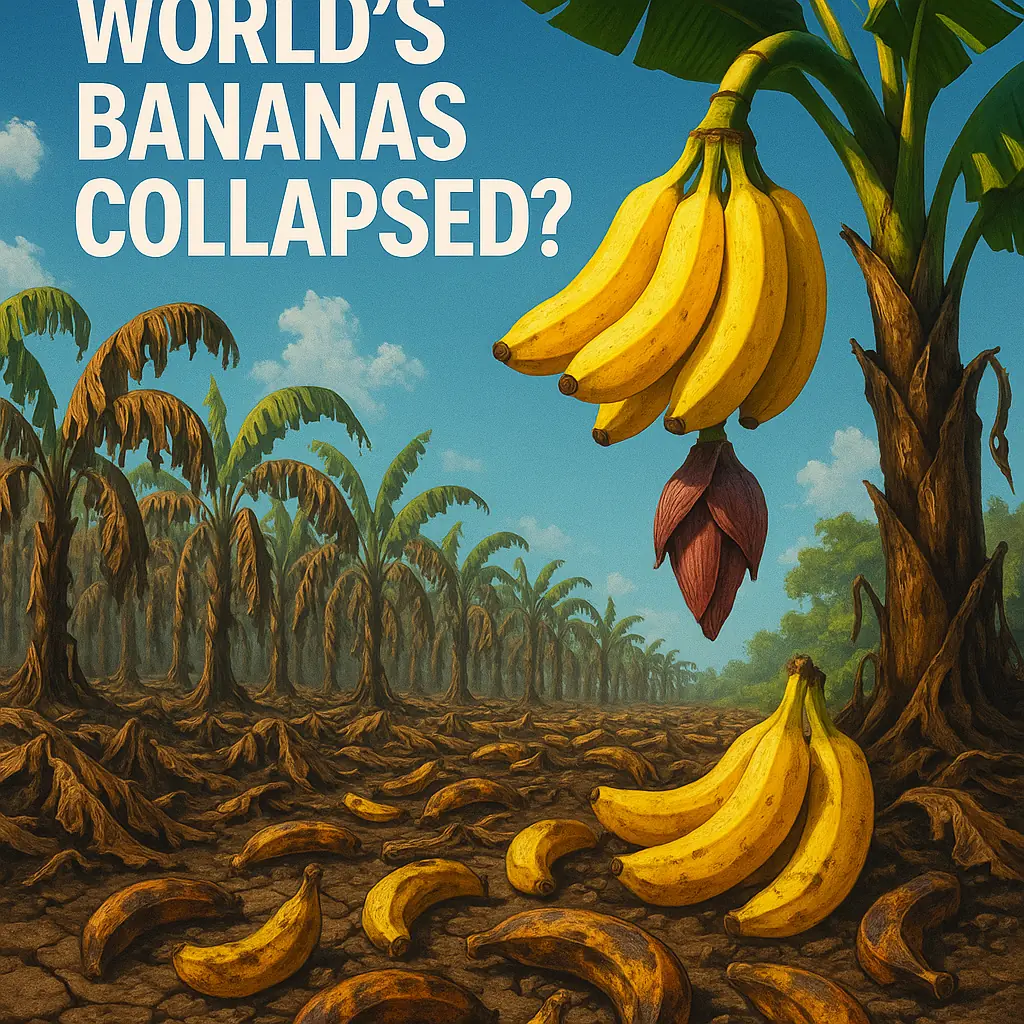
Imagine a pathogen sweeping through global Cavendish plantations, killing the plants faster than growers can react. No quick substitute replaces the taste, texture, and trade networks overnight. Expect food shocks, economic pain, cultural loss, and an agricultural scramble that lasts decades.
Timeline of consequences
Panic, short-shelf supply, and local shortages
Markets notice rotten or dying plantations and prices spike. Supermarkets limit purchases. Exporters reroute shipments and buyers hoard. Farmers in affected regions suffer immediate income loss. Restaurants and schools substitute other fruits and starches.
At the same time, quarantine zones spring up. Emergency teams sample soil and plant tissue to identify the pathogen. Consumers in importing countries feel occasional shortages and higher prices, but large-scale famine is unlikely because bananas are not the primary calorie source for most of the world.
Economic ripple effects and social strain
Plantations that relied on Cavendish either collapse or switch to riskier small-scale production. Countries whose export revenue depended heavily on bananas, like Ecuador, the Philippines, and some countries in Africa, face balance-of-payments stress and rising unemployment.
Local diets change where bananas were a staple. People substitute plantains, cassava, rice, or maize. Development programs and NGOs increase food aid in the worst-hit communities. Research labs scale up breeding and containment efforts.
Breeding, biotech, and farming redesign
Breeders and biotech firms push harder than ever. Some programs produce resistant cultivars by crossing with wild relatives. Others use gene editing to insert immune-like traits. These approaches take time; banana breeding is slow because of long generation times and complex genetics.
Meanwhile, farming systems change. Monocultures shrink, diversified agroforestry expands, and soil management practices are adopted to reduce disease carryover. Global trade patterns shift as importers seek new sources and exporters diversify crops.
Partial recovery, new bananas, and permanent losses
Expect partial recovery where resistant varieties succeed and where diversified farms become the norm. The supermarket banana will probably look different. Wild banana diversity preserved in gene banks and remote forests proves key for recovery.
Still, some local varieties and cultural uses will be lost forever. Economies that failed to transition face generational poverty, and some small farms disappear. The agricultural landscape in many tropical regions ends up less uniform and in some places healthier for it.
What science says
Modern bananas reachable in supermarkets are mostly one cultivar, the Cavendish. Farmers propagate them clonally through suckers or tissue culture. Clonal propagation keeps desirable traits constant, but it eliminates genetic diversity that would otherwise blunt epidemics.
Panama disease, caused by the soil fungus Fusarium oxysporum f. sp. cubense, is the best-known threat. A strain known as Tropical Race 4, or TR4, attacks Cavendish and survives in soil for decades. Fungus particles hide in tools, water, and even on footwear. Once established, removing it is extremely difficult.
Bananas are problematic to breed. Most edible varieties are sterile triploids that don't produce viable seeds. Crossing them with wild diploid relatives can produce fertile offspring, but backcrossing to recover desirable eating quality takes many generations. Gene editing and transgenic approaches shorten the timeline by directly adding resistance genes or editing susceptibility loci. Regulatory, cultural, and trade acceptance will affect how quickly modified bananas are adopted.
Other technical routes exist. Biological control and microbiome engineering aim to shift soil communities away from disease-supporting states. Quarantine and farm hygiene reduce spread. Importantly, wild Musa species and landraces conserved in gene banks are the raw material for long-term solutions.
Could anything survive?
Bananas collapsing is bad news for millions, but it is not a civilization-ending event. Practical responses split into containment, replacement, and rebuilding.
- Containment: Enforce strict biosecurity. Clean equipment, restrict movement of planting material, and map infected farms. Rapid diagnostics and coordinated regional action slow spread.
- Replacement crops: Shift immediately toward plantains, cassava, sweet potato, and local starches in diets where bananas are staple. These crops are resilient and easier to store at scale. Governments should subsidize seeds and inputs for quick transitions.
- Support for farmers: Cash transfers, retraining, and incentives to switch to diversified agroforestry reduce poverty shocks. Smallholders need credit and market access to plant alternatives and avoid forced land sales.
- Research and genetic rescue: Fund accelerated breeding, gene editing, and germplasm conservation. Prioritize field trials that test new varieties in local conditions and track yield, taste, and market acceptance.
- Supply chain adaptation: Supermarkets and exporters must accept alternative cultivars and new supply chains. Consumer education campaigns help rebuild demand for different banana types or replacement fruits.
- Environmental measures: Promote crop rotations, cover crops, and diversified landscapes to reduce pathogen build-up. Preserve wild banana habitats and expand germplasm banks and cryopreservation efforts.
At the household level, diversify diets, learn to store and process alternative crops, and support local producers. At national and international levels, coordinate trade policy, finance research, and build social safety nets to cushion transitions.