Survival meter
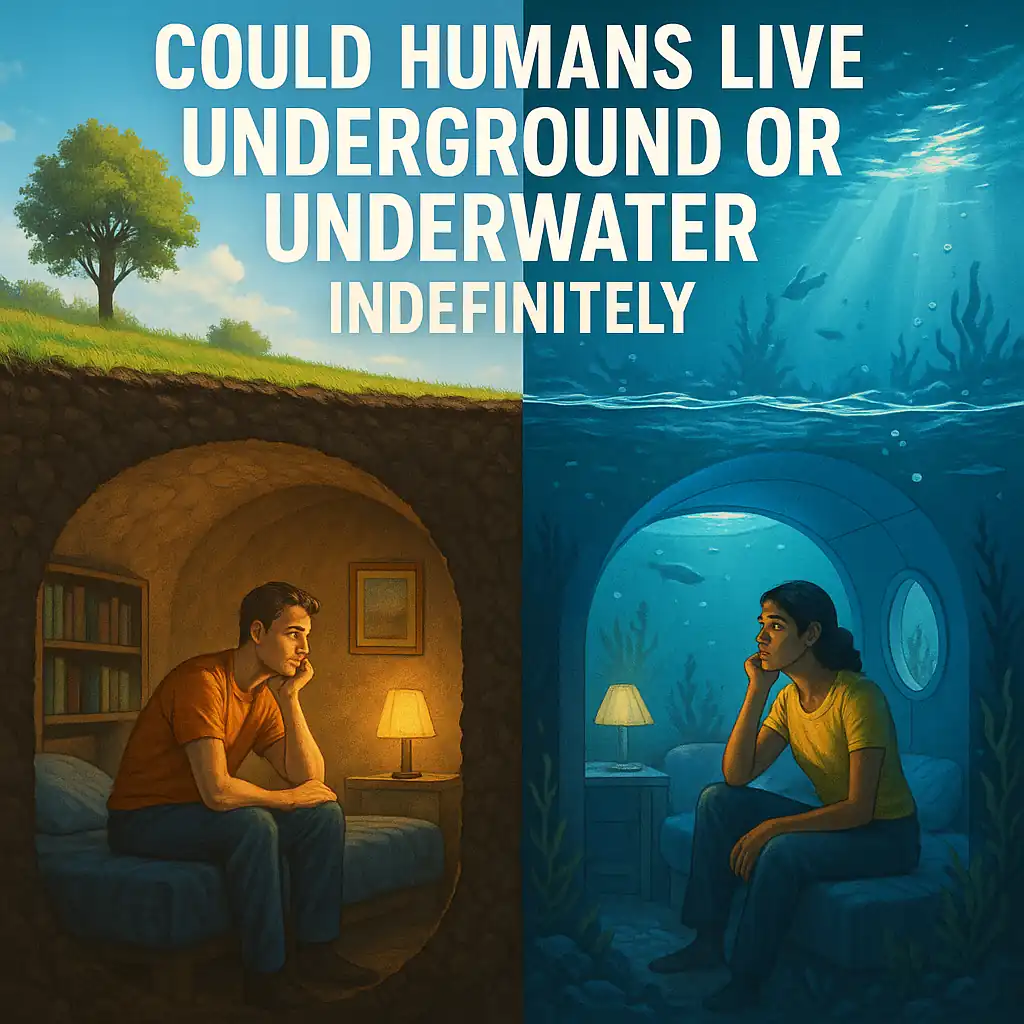
Humans have built homes in caves and dived under oceans for millennia. The question now is bigger: could we move off the surface and live below it forever? Short answer, maybe, but only with massive tradeoffs and relentless engineering.
Below ground and below sea present very different problems. One environment squeezes you with pressure, the other starves you of sunlight. Both demand perfect air, food, power and social structures that can survive isolation and slow collapse. Here’s what would happen if we tried to make either habitat permanent, what would break first, and how you might actually survive.
Timeline of consequences
Keep doing what we already do
We already have long-term underground and underwater habitats in limited forms: mines with living quarters, submarines, research stations and short-term underwater hotels. Technology for air recycling, hydroponics, and nuclear or grid power exists, but it is expensive and centralized.
Expect incremental improvements: more efficient LED horticulture, better closed-loop water systems, remote monitoring and robotic maintenance. Entire populations moving below the surface is still impractical.
Scaling habitats, testing limits
Engineers can scale habitats for thousands, not billions. Cities below ground or large underwater domes become demonstrators, not replacements. Key developments would be compact fusion or reliable advanced fission for stable power, cheaper artificial lighting, and robust life support that tolerates intermittent failures.
We'd learn more about psychological effects of low-UV living. Some people would choose the underground life. Governments might build refuges for climate refugees. But surface agriculture and trade would remain essential.
Semi-autonomous communities
If energy is abundant and closed ecological systems improve, entire communities could sustain themselves for generations underground or underwater. That requires near-perfect recycling of water and nutrients, resilient microbial control, and social systems that prevent cultural stagnation.
Biotechnological tweaks would probably be used: microbes tailored for waste processing, faster-growing algae, and medical interventions for bone loss and vitamin D deficiency. Still, full independence from surface resources remains difficult.
Long arcs and evolutionary pressures
If such communities persist for centuries, selection pressures could produce subtle physiological and cultural changes: altered sleep cycles, skin differences, different microbial flora. Cities below the surface might trade with the surface, not replace it.
Complete global migration below ground or under sea is unlikely without catastrophic surface conditions. Even then, maintaining biodiversity, soil, and open-air ecosystems would be a major unresolved task.
What science says
There are two sets of problems: physics and biology. Physics imposes pressure, heat, light, and energy constraints. Biology demands air, nutrition, immunity and fertile mates. Engineering has solutions for small scales. At planetary scales the equations change.
Pressure and structural limits. Underwater habitats face hydrostatic pressure that increases by about 1 atmosphere every 10 meters. Habitats can be pressure-balanced like submarines, or kept at surface pressure inside thick structures. Deep bore habitats avoid external pressure but require dealing with rock stress, flooding and geochemistry. Both approaches are expensive and failure-prone.
Air, circulation and temperature. You must provide breathable air and remove CO2 continuously. Chemical scrubbers, algae and microbial reactors can recycle air, but failures accumulate quickly. Heat disposal is another constraint. Underground and underwater spaces trap heat. Without large heat sinks, waste heat builds up and forces higher energy usage for cooling.
Food and closed ecosystems. Hydroponics, aeroponics, and vertical farming can produce calories efficiently under artificial light. Algae and fish farms perform well underwater. But closed-loop systems require precise nutrient recycling. Trace mineral depletion, pathogen proliferation and crop disease are persistent risks. Complete independence from surface inputs requires near-perfect waste reclamation and robust microbial management.
Light, vitamin D and circadian biology. Lack of natural sunlight affects bone health, mood and circadian rhythms. Vitamin D supplementation and engineered lighting cycles can mitigate many effects, but not all. Long-term reproductive health under low-UV conditions is uncertain.
Psychology and social structure. Humans evolved for open skies and variable environments. Crowded, low-variability habitats promote stress, aggression and cultural narrowing. Architecture, green space, enforced schedules and mobility corridors can blunt that, but social engineering becomes part of survival tech.
Energy and materials. Indefinite habitation needs abundant, reliable energy. Nuclear, geothermal and marine energy are the most realistic candidates. Material supply for repairs and expansion forces either ongoing trade with the surface or mature in-situ mining and refining. Extracting metals from seabed nodules or underground ores is feasible but resource intensive.
Could anything survive?
If you want to survive long-term below ground or below sea, plan for redundancy and simplicity. Build systems that fail safely and that people can maintain without specialists.
Site and structure
- Choose moderate depth. Shallow submerged habitats reduce pressure and make emergency surface access quicker. Shallow subsurface shelters avoid deep rock stress but still gain insulation and radiation protection.
- Design for modular isolation. Compartmentalize to contain leaks, fires and contamination.
Air, water and waste
- Have at least three independent air systems: mechanical scrubbing, biological (algae or plants), and chemical backups (lithium hydroxide or equivalent) for emergencies.
- Recycle water aggressively. Greywater and urine recycling systems are lifesaving. Maintain multiple filtration stages and offline sterilization.
- Treat waste as resource. Composting, anaerobic digesters and blackwater reactors recover nutrients for agriculture.
Food and power
- Prioritize high-yield crops and fast-growing protein sources: leafy greens, dwarf grains, insect farms, algae and aquaculture if water quality allows.
- Secure local energy. Small modular reactors, deep geothermal or ocean thermal systems provide steady baseload power. Battery banks and mechanical flywheels offer short-term buffering.
Health and social systems
- Implement strict infection control and microbial monitoring. Closed communities are vulnerable to a single pathogen.
- Maintain exercise regimens to counter bone and muscle loss. Use resistance rigs, vibration platforms and gravity simulators if needed.
- Manage light cycles and provide UV-mimetic solutions for vitamin D. Rotate personnel to external duty when safe to keep social and genetic links to the surface.
Governance and culture
- Create flexible governance that can adapt rules as systems fail or new information appears. Rigid hierarchies break down under chronic stress.
- Preserve cultural exchange with the surface. Trade, art and education are not luxuries. They keep innovation and social resilience alive.