Survival meter
Imagine entire human communities hermetically sealed away from the outside world. No open sky, no wild birds, no rain. Everything you need must be made, recycled, or grown inside steel, concrete, or composite walls. Sounds like a sci-fi premise. It is also a real engineering problem that people have been testing for decades.
Short answer: humans can survive in sealed habitats for a long time, but survival is not the same as flourishing. Expect hard engineering, stubborn biology, and social politics to determine whether sealed living becomes a sustainable option or a slow, fragile decline.
Timeline of consequences
Life support and the maiden run
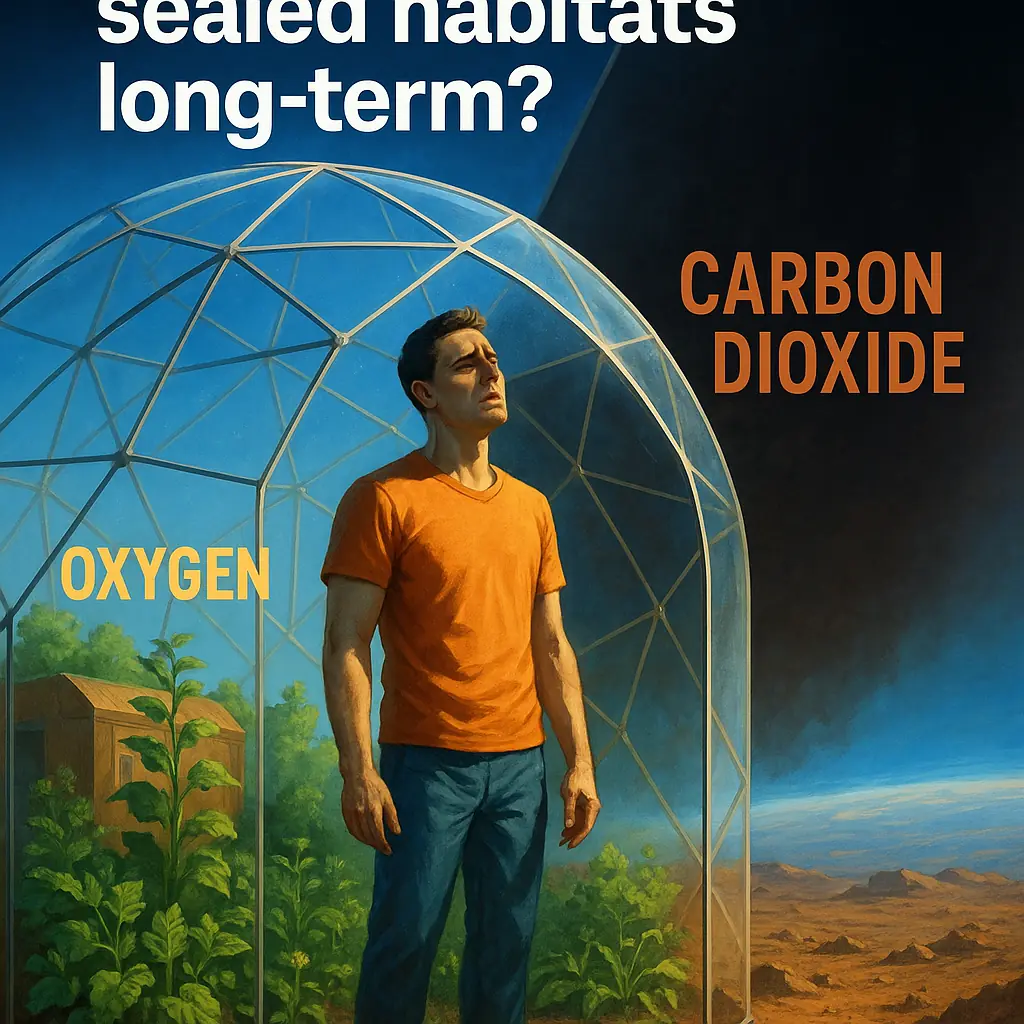
Initial survival depends on life support systems: air scrubbers, water purifiers, power, and food reserves. Early failures are usually mechanical or human error. The first few weeks reveal whether the habitat can keep oxygen, carbon dioxide and basic hygiene within safe ranges.
Short-term fixes are possible with stockpiles and repair crews. Redundant pumps and spare filters matter more than exotic tech.
Nutrient loops and microbial balance
After a few months, simple stores run low and recycling must kick in. Microbial systems that treat waste and regenerate water start to dominate daily life. Unexpected chemical byproducts and trace contaminants often appear. A scrubber might remove CO2, but trace organics can build up in recycled water.
Microbial ecology becomes a practical concern, not an academic one. A sudden bloom or die-off can change nutrient balance and food production.
Food systems go from dependents to the backbone
Hydroponics, aquaponics, and growth chambers replace imported food. Crop failures become high-stakes events. Pollination, pest control, and soil or nutrient media health are constant chores.
Crew skills shift toward agronomy, bioengineering, and machinery maintenance. Psychological effects of limited diets start to crop up, and cultural practices around food change fast.
Genetics, disease, and social resilience
Small, isolated populations face genetic drift, inbreeding risk, and pathogen evolution within a closed pool. Medical supplies and diagnostic capability become strategic commodities. New strains of microbes adapted to the habitat can emerge.
Social systems must handle resource allocation, governance, and conflict resolution. Societal collapse is rarely caused by a single technical failure. It happens when technical, biological, and social failures align.
Material entropy and manufacturing limits
Everything degrades. Metals corrode, polymers embrittle, fabrics wear out. A sealed habitat needs an industrial base to remake worn parts, process ores, or synthesize materials from biological feedstocks. If routine manufacturing can't continue, the habitat will slowly lose capability.
Recycling is never 100 percent efficient. Leakages, dust, and molecular contamination accumulate. Long-term survival hinges on in-situ production or reliable external resupply.
Cultural drift and long-term adaptation
Populations adapt in unexpected ways. Diets narrow or diversify depending on what grows best indoors. Religions, norms, and institutions evolve to prioritize maintenance and resource stewardship. Languages change. Some technologies are preserved deliberately, others slip into myth.
Genetic and epigenetic changes could occur, especially if selection pressures differ from the historical environment. The result could be humans well adapted to sealed life but less able to return outside.
If sealed habitats become the default
Long-term viability depends on external conditions and internal adaptability. If the outside world is inhospitable, sealed habitats might become islands of human life. If external repair or migration remains possible, sealed living is just one of several lifestyles.
Without biodiversity and external ecosystems, the planet’s wild systems would likely decline. Sealed humans could survive for long periods, but Earth would not be the same place.
What science says
Living in a sealed habitat is an exercise in applied ecology and systems engineering. At minimum you must manage air, water, food, energy, waste, and manufacturing. There are two broad approaches: physicochemical systems that scrub CO2 and supply O2 using tanks, filters, and electrolysis, and bioregenerative systems that use plants, algae, and microbes to recycle waste into food and air.
Historically, both approaches have limits. Physicochemical systems are predictable but require resupply of consumables and spare parts. Bioregenerative systems are more self-sufficient but messy. They introduce complex biological interactions and slow feedback loops.
Practical lessons come from Biosphere 2, space stations, submarines, and Antarctic stations. Biosphere 2 showed that closed systems can become chemically unbalanced and biologically unpredictable. Space stations show that a mix of closed-loop tech and resupply works for decades. Submarines show how crew psychology and mechanical reliability shape outcomes.
Key scientific challenges:
- Trace contaminants and chemical accumulation. Low concentrations of toxic organics or metals can build up over time.
- Microbial evolution. Microbes adapt to the habitat and can either help or harm recycling, food safety, and human health.
- Biodiversity needs. Pollinators, soil microbes, and a variety of crops reduce failure risk. Monocultures increase vulnerability.
- Energy and entropy. Closed systems still obey thermodynamics. You need a steady energy input, usually from sunlight or external power, to run pumps, lighting, and manufacturing.
Technology helps. Synthetic biology can create microbes tailored to recycle waste and produce nutrients. Additive manufacturing and modular systems reduce spare-part bottlenecks. Still, no known system is perfectly closed. Every loop has leaks and inefficiencies.
Could anything survive?
If you were building or joining a sealed habitat, you would prioritize redundancy, diversity, and governance.
- Redundancy. Duplicate critical systems: power, air processing, and water treatment. Keep stocks of common spare parts and maintain the capability to fabricate others.
- Diversity of food systems. Combine fast-growing crops, perennials, algae, and small livestock when possible. Use polycultures and integrated pest management to avoid single-point crop failures.
- Microbial management. Maintain microbial culture banks and diagnostics. Regularly monitor water and air chemistry for trace contaminants and have protocols for microbial outbreaks.
- Energy strategy. Secure a reliable, preferably renewable, energy source. If sunlight is limited, run high-efficiency LEDs, thermal systems, and energy storage. Energy deficits are the single largest systemic risk.
- Manufacturing and materials. Build a materials-processing chain: recycling plants, basic metallurgy, polymer synthesis, and 3D printing. Plan for gradual material loss and design systems that are maintainable over generations.
- Population size and genetics. Maintain a large enough, genetically diverse population to avoid inbreeding and allow robust labor specialization. Preserve seed banks, cryopreserved gametes, and biological archives.
- Social design. Implement transparent governance, conflict-resolution mechanisms, and rotation of responsibilities. Mental health programs and access to meaningful work reduce social fractures.
Short-term steps for new habitats:
- Run parallel systems for months before transferring full reliance.
- Establish routine environmental monitoring and public dashboards for transparency.
- Prioritize crew cross-training in agronomy, mechanical engineering, and medicine.
Long-term survival is not just a technical problem. It is a question of whether social institutions can prioritize maintenance, adapt to slow failures, and hand knowledge across generations.