Survival meter
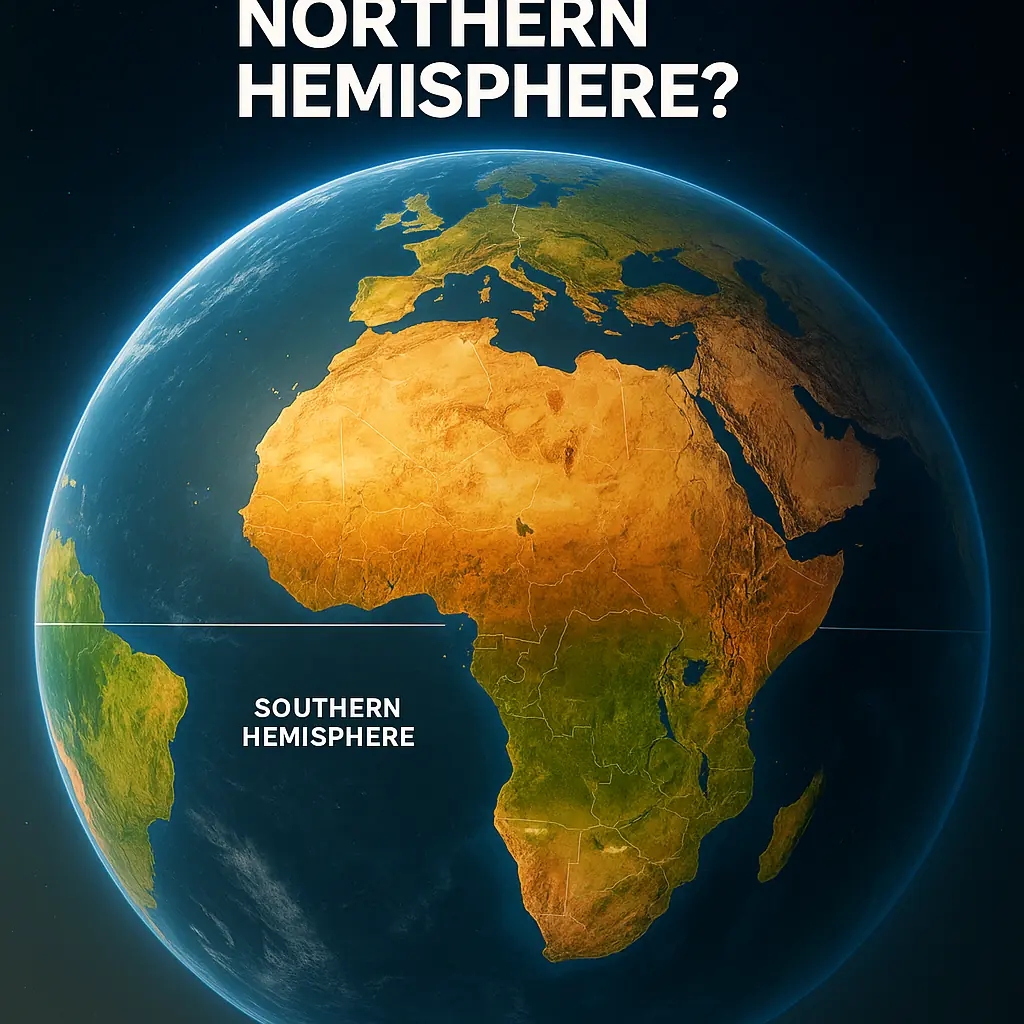
Imagine sliding the African landmass northward so that no point lies south of the equator. This single latitudinal shift — on the order of 3,800–4,000 km — keeps the continent's shape and geology unchanged but moves its climate belts, ocean margins, and human societies into a different hemispheric context. The result is a cascade of fast and slow consequences: altered rainfall patterns, re-routed ocean currents, rearranged biodiversity, and a remapped geopolitics.
Timeline of consequences
Immediate optical and calendar effects
Sunrise, sunset and the calendar do not change globally, but every point on the shifted continent experiences a different seasonal intensity for its latitude. Regions that were in austral (Southern Hemisphere) seasons now follow Northern Hemisphere seasonality — for instance, what used to be South African winter would align with boreal winter months. Day length at each location changes only by virtue of latitude changes.
Rapid climate and weather regime shifts
Atmospheric circulation reacts quickly. The Intertropical Convergence Zone (ITCZ) and monsoon trough re-position relative to the new land geography, changing the timing and amount of rainfall in many regions. Coastal upwelling and sea-surface temperatures adjust as ocean currents start responding to the continent's new location, altering fisheries productivity within a few years.
Agriculture, health, and migration pressures
Growing seasons change latitude-wise: some crops win, others fail. Malaria, dengue and other vector ranges shift with temperature and rainfall. Human migration accelerates from newly arid or flood-prone areas into hospitable zones and cities. Urban infrastructure designed for previous climates faces stress.
Ecosystems reorganize; extinctions and invasions
Species that cannot disperse fast enough or that rely on narrow coastal and climatic conditions suffer extirpation. New assemblages form as northern-adapted species move in or survive where southern competitors cannot. Coral communities and marine life along formerly southern coasts may experience long-term temperature and current changes, with knock-on effects for fisheries and coastal protection.
Planetary climate feedbacks and geopolitics
Persistent hemispheric land–sea distribution changes can alter planetary albedo, atmospheric wave patterns and possibly the strength of ocean circulation over long timescales. Political borders, trade routes and resource geopolitics evolve around new agricultural belts, shipping lanes and mineral access, reshaping regional and global power balances.
What science says
Key physical drivers explain the main changes.
- Latitude controls climate: Moving a location north alters its mean solar angle, seasonally available energy, and the prevailing climate zone (tropical, subtropical, temperate).
- Hadley cells and the ITCZ respond: Tropical rainfall belts and monsoonal circulations track heating patterns over land. A northward-shifted Africa would steer the ITCZ and monsoon maxima north of their present positions over many regions.
- Ocean currents and sea-surface temperature: Currents like the Benguela, Agulhas and Canary are shaped by coastline geometry and winds. Shifting the continent changes wind stress patterns and the relative positions of warm and cold currents, with consequences for regional marine ecosystems and possibly for broader features like the Atlantic Meridional Overturning Circulation (AMOC).
- Biogeography and dispersal limits: Species' ranges are constrained by temperature, rainfall and barriers. Rapid latitudinal displacement of entire habitats forces either adaptation, migration, or extinction. Islands of suitable habitat can fragment, reducing genetic exchange.
- Hemispheric asymmetry: Earth already has more land in the Northern Hemisphere; adding all of Africa northward increases that asymmetry. This changes inter-hemispheric heat transport and could subtly shift storm tracks and jet stream positions over long periods.
What is likely versus speculative: shifts in rainfall belts, growing-season reconfiguration, and ecosystem turnover are highly likely. Large-scale changes to global thermohaline circulation or dramatic, immediate global climate collapse are low-probability and more speculative — they depend on complex feedbacks and rates of ocean adjustment.
Could anything survive?
If human societies had to adapt to a northward Africa, practical strategies would reduce harm and preserve options:
- Anticipate and redesign agriculture: Map new agro-climatic zones and accelerate the introduction of appropriate crops, crop varieties and irrigation systems. Preserve seed banks and fast-track breeding for heat, drought and season-shift tolerance.
- Water management and infrastructure: Invest in water storage, desalination along affected coasts, and flood defenses where new wet seasons intensify runoff. Upgrade urban drainage and cooling infrastructure in cities facing hotter summers.
- Public health readiness: Strengthen disease surveillance, vector control, and vaccine distribution in regions entering higher vector-borne disease risk.
- Conservation triage: Protect and connect climate refugia, create corridors for species migration, and prioritize protection for endemic and slow-moving species (e.g., large mammals, specialized plants).
- Economic and social policy: Support migration pathways, retraining programs, and adaptive governance for transboundary resources like river basins whose hydrology changes.
Short-term actions buy time; long-term resilience depends on flexible institutions, international cooperation on water and fisheries, and investments that reduce vulnerability to shifting climates.