Survival meter
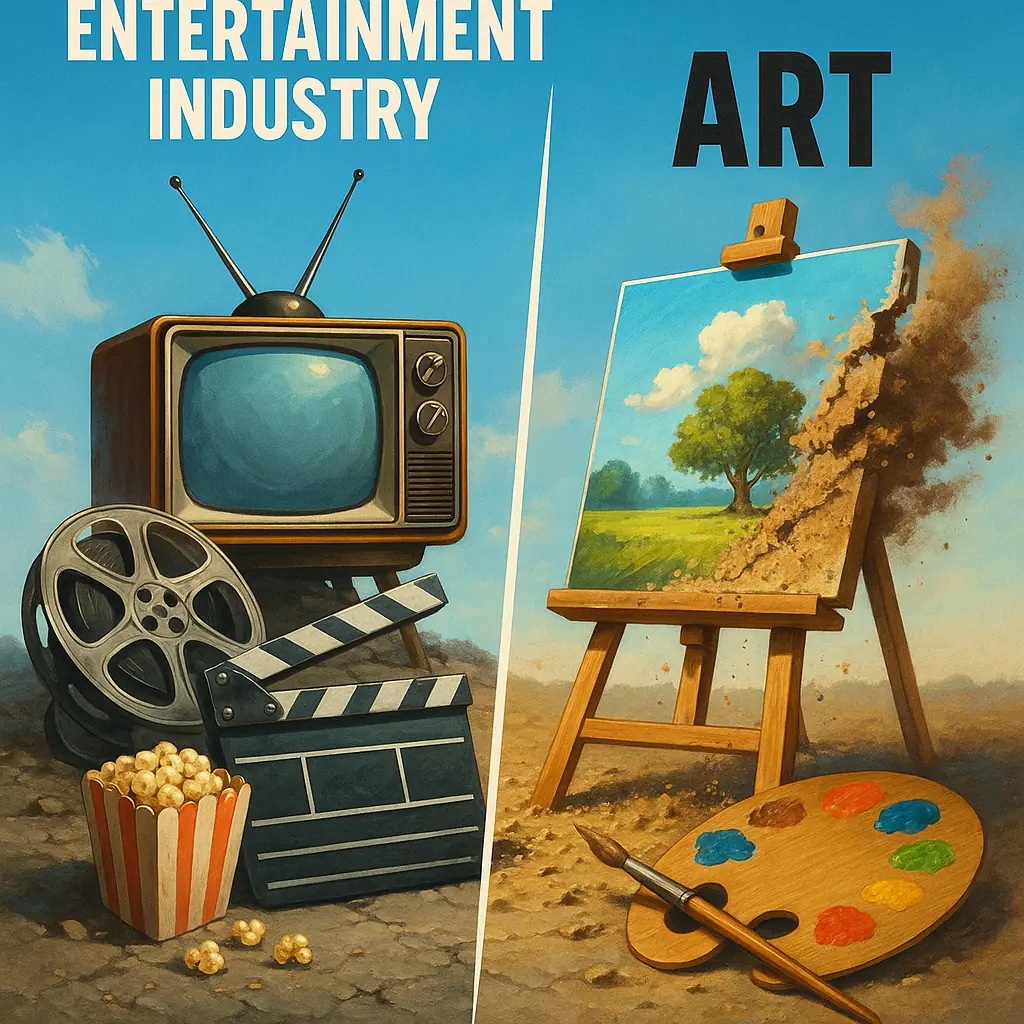
Picture the lights going out on every major studio lot, every streaming server, and every corporate concert promoter. The machines that mass-produce, market, and distribute movies, TV, music, games, and live spectacles are suddenly gone. Entire corporate ecosystems evaporate overnight.
Would art vanish with them? No. Art is not the industry that packages it. It is human behavior, a way people make meaning, connect, and shape objects and experiences. But the form, scale, and survival of art would change fast. The popular, the professional, and the archival systems that people take for granted would take the biggest hit.
Timeline of consequences
Chaos on the airwaves and squares
Distribution collapses. Big-name releases are canceled. Stadium tours, summer blockbusters, and serialized TV disappear from calendars. Millions of workers, technicians, venue staff, marketers, are suddenly unemployed. Ticketing systems and centralized streaming platforms go dark or become unreliable.
Grassroots responses appear within days. Local radio stations, DIY venues, and social media communities try to pick up the slack. People share films, songs, and performances peer to peer. Informal networks buzz. The show does not stop, it fragments.
Rebuilding at human scale
Professional artists face lost incomes. Big-budget projects stall because they need teams, specialized equipment, and distribution. Some migrate into teaching, local gigs, or new crafts. Others form cooperatives, pooling resources to finance mid-scale work.
New funding models emerge. Patronage returns in looser forms: crowdfunding, subscription patrons, local arts funds, and private benefactors. Low-cost production flourishes. Street art, community theaters, and independent publishers grow. The public sees more varied, smaller-scale work but less of the spectacle that required hundreds or thousands of hands.
A different cultural landscape
Large-scale spectacle is rare. Some traditions die out, especially those dependent on complex supply chains and specialized skills, like certain practical effects or orchestral tours. Other forms adapt. Musicians tour regionally, ensembles perform in community centers, filmmakers shoot for fewer locations with smaller crews.
Networks of archives and museums scramble to preserve digital and physical assets. If centralized archives dissolved with the industry, many works risk being lost, especially proprietary or ephemeral pieces like live broadcasts. Communities organize salvage efforts. Analog media experiences a resurgence for preservation purposes.
Art persists, but memory frays
Art survives because humans are creative animals. Cultural expression becomes more local and hybrid. New traditions start; old ones are sometimes reinvented. The canon of mainstream culture fractures. Some blockbuster-era works survive in private collections and community archives. Others vanish, especially if their preservation depended on corporate stewardship.
Over generations, popular memory rewrites itself. Certain genres and formats may be rediscovered, repurposed, or mythologized. Scholars and hobbyists become key guardians of lost-production techniques and archival recovery.
What science says
Why would art persist? The answer sits at the intersection of psychology, anthropology, and technology. Humans evolved to tell stories, make music, decorate objects, and mark group identity. Those behaviors engage reward systems in the brain. Creating and consuming art helps people cope with stress, coordinate socially, and transmit ideas across generations. Remove the industry and those drives do not vanish.
Cultural systems, however, have layers. The entertainment industry sits atop a base layer of private practice, ritual, and community arts. Historically, large-scale patronage and markets have waxed and waned. Before mass media, storytelling, music, and visual expression thrived in courts, temples, taverns, and marketplaces. When centralized patronage collapsed, smaller systems took over. Think of medieval troubadours, or the 19th-century salons that supported composers outside of institutional sponsorship.
Technology shapes possibilities. High-fidelity film, orchestral touring, and AAA game development require complex supply chains, specialized labor, and large capital. Without that infrastructure, those particular art forms contract. But low-cost digital tools, home recording, and distributed publishing lower the barrier to entry for many creators. Decentralized networks can distribute content but cannot perfectly replace large marketing budgets or the logistical muscle required for mass live events.
Archives and preservation are scientific problems too. Digital data is fragile without maintenance. If corporate servers and centralized catalogs disappear, metadata and backups may be lost. Physical media ages. Saving art in a long-term, accessible way requires institutional attention, which the vanished industry may have supplied at scale.
Could anything survive?
Artists, curators, and audiences would need to adapt fast. Here are practical steps for survival and for preserving cultural memory.
- Decentralize distribution. Use peer-to-peer sharing, community-run servers, and resilient file systems like distributed ledgers or physically redundant backups. Mirror important catalogs across institutions and private owners.
- Create local infrastructure. Turn theaters, schools, and churches into multiuse venues. Form cooperatives to share gear and payroll, and to book regional tours that don't depend on transcontinental logistics.
- Train and transfer skills. Document specialized crafts: set-building, film projection, large-ensemble coordination. Workshops and apprenticeships will keep complex techniques alive even if large employers vanish.
- Preserve analog backups. Print scores, archive film negatives, and store master audio on durable media in climate-controlled community archives. Analog formats can be simpler to access when digital ecosystems fail.
- Reinvent funding. Local arts taxes, membership cooperatives, micro-patronage, and philanthropic unions can replace lost corporate funding. Transparent governance keeps patronage accountable.
- Protect intellectual property thoughtfully. Simplified, permissive licenses can help works survive by allowing communities to maintain and reproduce content when original owners are unreachable.
Not every artist will be able to remake an arena tour, and not every lost archive can be recovered. But the practice of art is resilient. With planning and collective action, much can be preserved and remade in new forms.