Survival meter
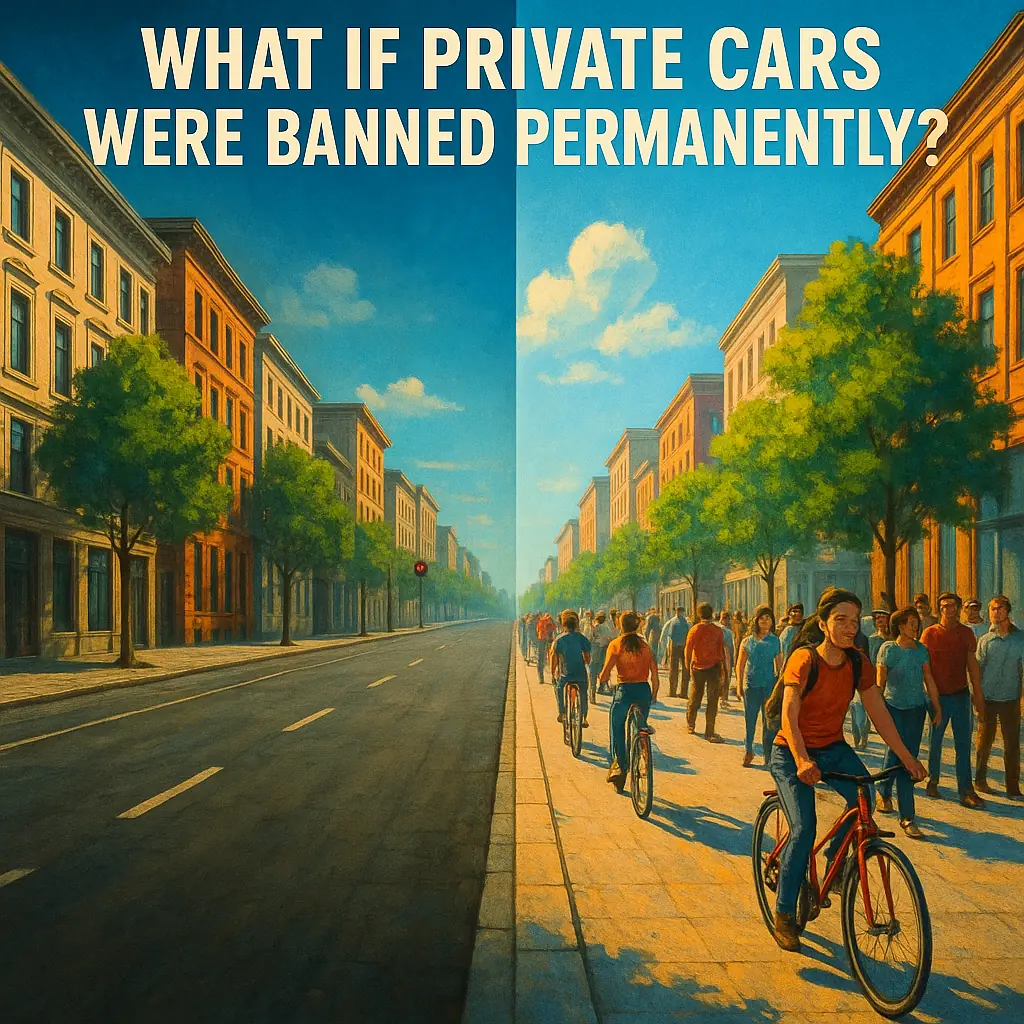
Imagine a world where no one is allowed to own or park a private car. Not a temporary restriction, not a city pilot, but a permanent legal ban. Streets reconceived, garages reused, a whole industry repurposed. The idea sounds radical. It is also a concrete policy option some cities flirt with when traffic, pollution, and land use all reach breaking points.
How would daily life change? Who wins, who loses, and how fast would the effects arrive? The short answer: cities would transform, rural areas would struggle, the economy would rewire, and the climate would get a real assist. The long answer is messy, and that is where the trade-offs live.
Timeline of consequences
Immediate disruption and adaptation
The first months would be chaotic. Millions of people would need alternatives for commutes, school runs, and errands. Sales and manufacturing of new private vehicles would collapse overnight. Used cars would flood secondary markets where legal loopholes exist, and enforcement would tax police and administrative systems.
- Public transit demand spikes. Trains, buses, trams and microtransit services see rapid overloads.
- Delivery logistics scramble. Couriers move from personal vans to consolidated fleets and cargo bikes.
- Household mobility pivots to cycling, walking, carpooling, and shared fleets where permitted.
Rebuilding mobility and infrastructure
Policy and investment decide whether a ban becomes a win for most people or an urban hardship. Cities that invest in frequent transit, protected bike networks, and pedestrian-first planning see congestion fall and travel times stabilize. Suburbs and exurbs face longer commutes unless connected by fast regional rail, express buses, or mobility hubs.
- Shared mobility systems mature. Subscription ride services, autonomous shuttles, and municipal fleets replace private trips for many.
- Land formerly for parking gets redeveloped into housing, parks, and solar arrays.
- Transport and auto sectors shift jobs from private sales to fleet operations, maintenance, and logistics consolidation.
Economic and social reordering
Pattern changes become durable. Urban density rises where transit is strong. Energy use drops in transport, cutting fuel imports for many countries. Neighborhoods regain streets for people rather than parking lots and idling cars. Inequities become clearer: well-served areas flourish, poorly served ones stagnate unless special measures are adopted.
- Automotive manufacturing focuses on commercial and public fleets, specialized vehicles, and exports.
- Health benefits from increased active travel reduce rates of heart disease and some cancers.
- Property values shift toward transit corridors and walkable neighborhoods.
New defaults and unforeseen side effects
Generations grow up without private cars as a taken-for-granted right. Urban form reflects that absence; fewer roads are prioritized for throughput and more for people. Energy grids and shipping systems adapt, but unexpected issues appear. Rural depopulation accelerates in places that cannot connect affordably to people-centric transport networks. Black markets and legal exceptions persist in some regions.
What science says
The physics and emissions math are simple: personal cars are an inefficient use of energy and space. Most private trips carry one or two people in vehicles that sit idle 95 percent of the time. Removing private cars reduces total vehicle kilometers traveled if good alternatives exist, which cuts direct carbon emissions, urban air pollution, and noise.
But the outcomes depend on modal shift and energy source. Electric shared fleets charged from dirty grids still replace a lot of tailpipe pollution but leave a carbon footprint. The biggest gains come when private car trips shift to walking, cycling, and high-capacity transit, and when electricity for fleets comes from low-carbon sources.
Urban heat and land-use effects are striking. Parking consumes large swaths of central-city land. Reclaiming that footprint lowers impervious surfaces, increases tree cover, and reduces heat islands, which improves public health during heat waves. Less idling traffic means lower concentrations of fine particles and nitrogen oxides near schools and hospitals, delivering measurable health benefits.
Economic science warns about transition costs. The auto industry employs millions worldwide. A ban forces capital reallocation, retraining, and likely short-term unemployment in manufacturing and private car services. Growth will happen in transit construction, fleet management, last-mile logistics, and urban redevelopment, but not all job shifts are one-to-one.
Equity and geography matter. Dense cities with ready transit would capture most benefits. Sparse rural regions, suburbs, and places with poor investment are at risk of isolation. Without targeted subsidies and creative mobility programs, a permanent ban could deepen inequality.
Could anything survive?
People and communities adapt fast when incentives and infrastructure align. On the ground, survival means planning travel differently, lobbying for services, and retooling businesses. Here are practical steps for individuals, local governments, and businesses.
- Individuals: Learn to live without a car. Try cargo bikes for shopping, time your trips to avoid peak loads, use regional rail for longer commutes, and join community ride or delivery cooperatives.
- Households: Declutter garages into rental units or community spaces. Share subscriptions to mobility services instead of private ownership. Keep a small emergency fund or contingency plan for long-distance travel needs.
- Communities: Push for frequent local transit and safe cycling routes. Turn parking lots into mobility hubs with lockers, charging stations for fleet vehicles, and parcel consolidation centers.
- Businesses: Shift logistics toward consolidation, micro-fulfillment centers, and night deliveries. Re-skill workers from car sales and repair toward fleet maintenance and urban freight services.
- Governments: Invest in high-frequency radial and orbital transit, subsidize rural connections, and set up mobility vouchers for low-income households. Regulate fleet emissions and require data sharing to optimize routes and reduce empty vehicle miles.
Emergency services need special planning. Ambulances and fire services still require rapid local access. Governments should exempt or create dedicated public-service vehicle classes that are strictly regulated, pooled, and optimized to prevent the ban from degrading life-or-death response.