Survival meter
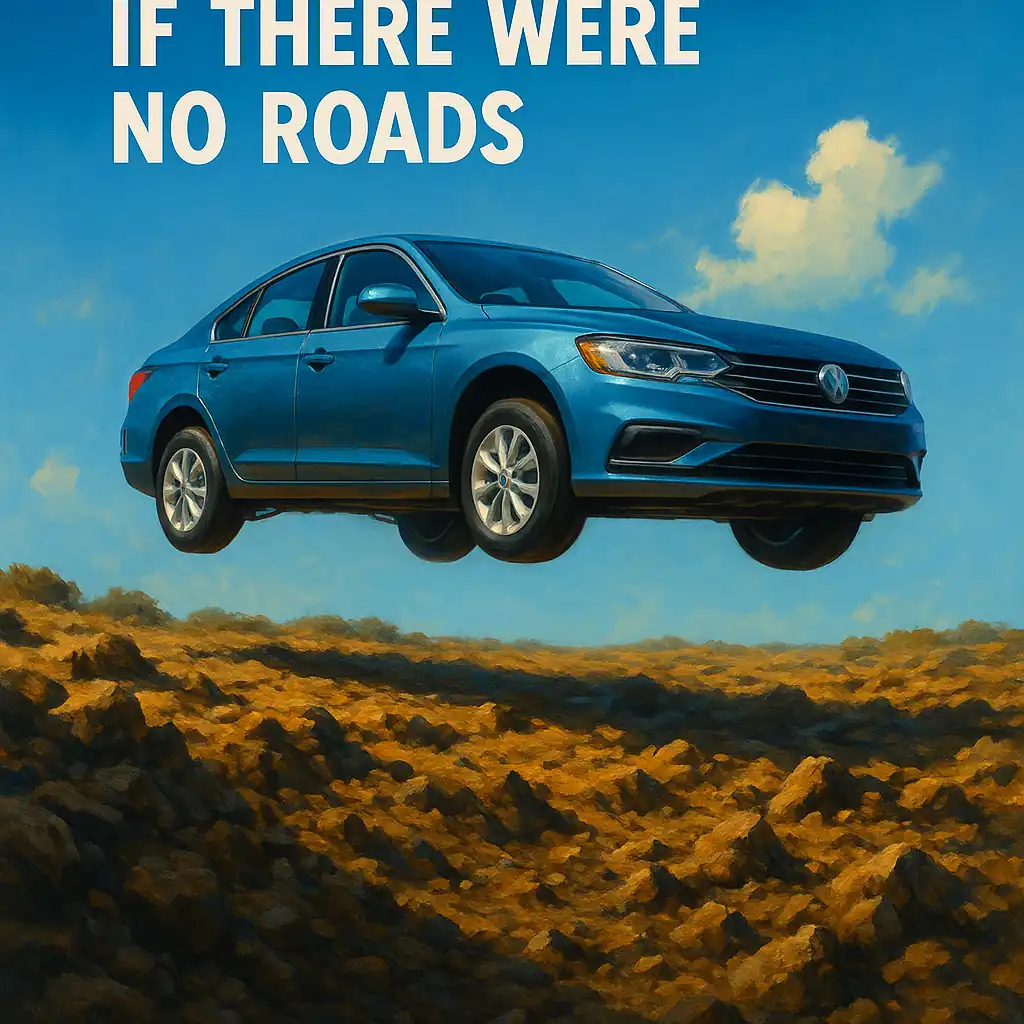
Most people picture cars and highways as inseparable. But what if humans never built continuous road networks—no paved, planned corridors between towns and cities? Wheel technology predates roads by millennia, yet roads and cars evolved together. This scenario explores how transportation, technology, and society might change if engineered roads were absent: which kinds of automobiles would appear, how they would be used, and what we would lose or gain.
Timeline of consequences
Wheels without roads
The wheel and axle appear long before sophisticated roads. Early wagons and chariots traveled on animal tracks, open plains, and beaten earth trails. In a no-roads world those same simple wagons and sledges remain vital for local hauling: farm carts, wheelbarrows, and chariots for ceremony or war. Mobility stays local and seasonal, tied to terrain and animal power.
Engines find other veins
The steam engine revolutionizes transport even without roads. Railways, canals, and coastal shipping become dominant long-distance conduits because they require only a single engineered surface (rails or cut canals) rather than a continuous network of roads. Early 'automobiles' are more likely to be railcars, steamboats, or heavy off-road steam tractors used on farms and military fronts.
Off-road inventions and niche cars
Internal combustion engines enable self-propelled vehicles not tied to animals. Without roads, manufacturers focus on two directions: (1) robust, low-pressure-tyre or tracked vehicles for farms, resource extraction, and military use; (2) rail-compatible petrol locomotives and small railcars for passenger service. Mass-market personal cars struggle because comfortable, economical long-distance travel still requires continuous corridors.
Specialization instead of mass motoring
Urban planning adjusts: cities cluster around harbors, railway hubs, and navigable rivers. Personal motor vehicles exist, but they look and behave differently—high-clearance 4x4s, tracked minibuses, and amphibious craft—designed to traverse uneven terrain, river crossings, or reach railheads. Air travel and local tram or monorail networks fill gaps for longer journeys.
Technology fills the gaps
Advances in suspension, lightweight composites, and autonomous navigation make off-road vehicles safer and more efficient. Drones and small aircraft deliver people and goods across difficult terrain. Where economies can afford it, private lanes—improved tracks or compacted corridors—appear, creating semi-road systems that look like narrow, linear infrastructure rather than broad highway networks.
What science says
Roads are not a prerequisite for wheels, but they shape what kinds of wheeled transport become practical and economical. The key engineering trade-offs are traction, rolling resistance, suspension, and infrastructure costs.
- Rolling surfaces: Wheels are most efficient on smooth, continuous surfaces. Without them, designers minimize rolling resistance by using large-diameter wheels, low-pressure tires, or continuous tracks that distribute weight over soft ground.
- Powertrain and fuel: Internal combustion and electric drives can power off-road vehicles, but fuel logistics shift. Rail and waterways concentrate fuel use along nodes; distributed fueling networks that support millions of private cars are unlikely without roads.
- Suspension and control: Rough terrain demands robust suspension, active articulation, and often lower speeds. These constraints favor specialized designs—military-style all-terrain vehicles, articulated trailers, and amphibious craft—over light, cheap commuter cars.
- Infrastructure substitution: Rails and canals are targeted investments that connect high-demand corridors. They give high capacity per unit investment but lack the flexibility of a full road grid. As a result, personal mobility is more expensive and selective, with hubs acting as transfer points.
In short, automobiles would arise in technical forms adapted for poor surfaces or for use on other engineered paths (rail, canal towpaths, or compacted tracks). The social and economic scale of private car ownership would be much smaller unless alternative, low-cost corridor systems evolved.
Could anything survive?
Living in a world without roads changes everyday survival and logistics. If you must travel or move goods, practical choices and skills matter more than the vehicle you drive.
- Choose the right vehicle: For rural travel use low-pressure-tyre 4x4s, tracked vehicles, or ATVs. For river-rich regions, boats and ferries are often faster and more reliable.
- Learn navigation and terrain skills: Map-reading, off-trail navigation, and seasonal planning avoid impassable bogs, snowfields, and floodplains. Travel windows are narrower.
- Prioritize fuel and maintenance: Carry spare parts, tools, and portable repair kits—off-grid repairs are common. Optimize fuel by using the most efficient transport for each leg (boat for bulk goods, rail for distance, off-road vehicle for last-mile).
- Use hubs and relays: Plan journeys via railheads, harbors, or established trails. Pack animals and human porters remain economic choices for short-range transport in some landscapes.
- Community solutions: Shared vehicles, scheduled freight ships, and local workshops reduce the need for every household to own a costly off-road vehicle.
For explorers and emergency responders: travel light, move in convoys, and scout routes ahead. Expect slower average speeds and higher fuel consumption than on paved roads, but enjoy lower traffic congestion and potentially safer wildlife encounters.