Survival meter
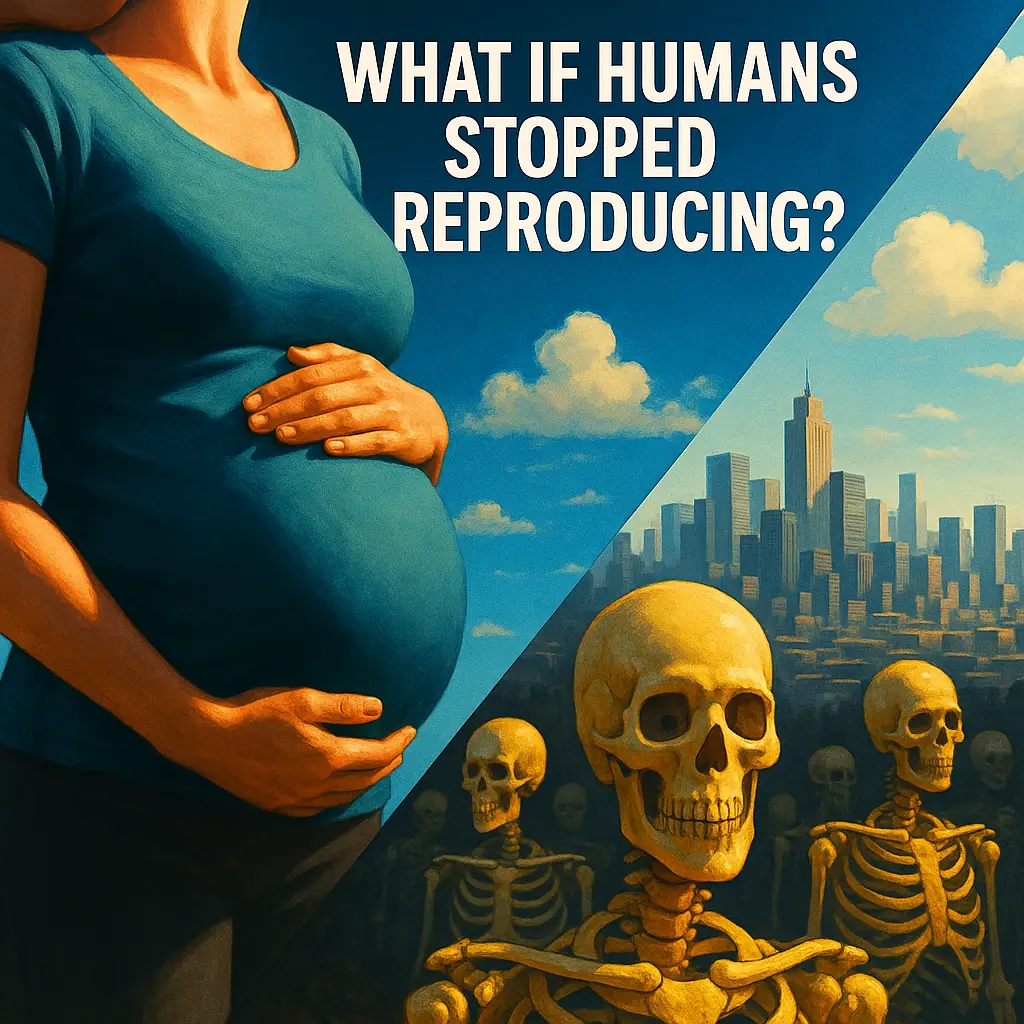
Imagine a world where no baby is born ever again. Not a slow decline, not a demographic slowdown. Zero births, starting tomorrow. The idea sounds like science fiction. It is also a clear thought experiment with sharp, uncomfortable consequences.
Fewer people makes some problems easier. Other problems get worse, fast. An aging planet of adults is not stable forever. The clock on humanity would start counting down the day the last child is born.
Timeline of consequences
Immediate shock: services strain and markets reprice
Population begins falling at the current global death rate of roughly 60 million per year. Economies feel it quickly where demographics are already old. Pensions, healthcare, elder care, and social insurance systems start running short of workers and money.
Labor shortages concentrate in physically demanding and routine jobs first, while professional services limp along thanks to automation and older specialists. Consumer markets shrink. Real estate and schools collapse in value in neighborhoods full of retired people.
Aging societies and failing maintenance
More than half the population moves into retirement-age brackets in many countries. Agricultural production struggles as the pool of farmworkers and technicians shrinks. Critical infrastructure begins to show signs of deferred maintenance: bridges, roads, wastewater systems and remote power plants get less attention.
Social structures erode. Fewer children means fewer caregivers for the very old. Healthcare systems face moral and logistical triage. Urban areas experience a slow hollowing out while smaller towns age faster.
Technical collapse and cultural loss
The workforce decline accelerates as mortality among older cohorts grows. Highly technical industries lose institutional knowledge when senior engineers and operators die without successors. Nuclear plants and large dams become higher risk without steady staffing and oversight.
Books, skills and languages that depend on intergenerational transmission start to vanish. Domestic breeds of animals and heirloom crops that require human stewardship begin to disappear. Cities become harder to maintain; some are abandoned entirely.
The endgame for people and civilization
No births means every living person is part of a finite cohort. The youngest individuals are today’s infants, who will die within a human lifetime. Unless something intervenes, the last humans would probably die within about 100 to 150 years, assuming no radical life-extension breakthroughs.
Complex civilization, as we know it, collapses long before the final human dies. A handful of automated systems may hum on for years, but without people to repair, adapt and reboot, most large-scale systems fail.
After humanity
If no new humans ever exist again, nature reclaims most human constructions. Cities break down, soils recover in many places, and many domesticated species go extinct or feral. Persistent hazards remain for centuries, such as poorly secured radioactive sites and industrial chemicals.
Some knowledge might survive in buried archives and durable media. A future intelligence, natural or artificial, might find those records. Biological life on Earth continues without us, but with a very different planetary footprint.
What science says
Population dynamics are straightforward when reproduction drops to zero. The only thing changing population size is mortality. Right now the youngest cohort includes newborns. With no further births, the last human will be one of those newborns, so a hard upper bound on species survival is roughly the maximum human lifespan, likely under 150 years.
Age structure matters a lot. Countries with older populations feel the economic shock faster. Fertility trends make a difference if the decline to zero is gradual rather than immediate. A gradual fall lengthens the tail, but does not stop eventual extinction if births remain below replacement.
Beyond arithmetic, technical realities matter. A complex civilization relies on continuous training, apprenticeship and replacement. Engineers, farmers, nuclear technicians and doctors are not easily replaced from existing cohorts once retirements and deaths outpace training pipelines. Many modern systems require constant human attention. If the number of capable technicians falls, critical infrastructure degrades and systemic failures cascade.
Ecology reacts too. Fewer humans means lower greenhouse gas emissions and less land conversion, so many ecosystems would recover. But that recovery is nonlinear. Some domesticated species would vanish without humans to breed and manage them. Invasive species and diseases could spread differently with changing human presence. The net effect on ecosystems is very likely positive for wild biodiversity in many regions, but not uniformly so.
Could anything survive?
If your goal is to extend human presence as long as possible after reproduction stops, focus on three things: preserve genetic options, keep critical infrastructure running, and protect knowledge.
- Preserve germplasm and embryos. Global, redundant cryopreservation of sperm, eggs and embryos is the only direct way to restart a population without natural reproduction. That requires stable cold chains, redundant power and legal frameworks to use material in the future.
- Prioritize infrastructure that keeps people alive. Medical supply chains, food production systems, water and waste treatment must be stabilized. Decentralized renewable energy and microgrids are easier to maintain with a shrinking population than large, centralized networks.
- Archive actionable knowledge. Durable records of engineering, medicine, crop breeding and governance should be stored in multiple formats and locations. Practical manuals and curricula for training technicians must be prioritized over abstract scholarship.
- Automate where possible. Robotics, automated agriculture and remote monitoring can substitute for declining labor. But automation needs maintenance. Systems that are self-correcting or simple to repair are better bets than highly specialized ones.
- Protect domesticated species and seeds. Seed banks, living collections and managed herds can keep agricultural biodiversity available. Without them, many food varieties and livestock breeds will disappear, reducing recovery options.
Be realistic about limits. Without either resumed reproduction or a successful program to gestate and raise humans from stored embryos at scale, extinction is inevitable. The best survival strategy is a combination of technical preservation and practical triage: stabilize the systems that keep people alive now, and create the options that let future survivors restart the species if choices or technologies change.