Survival meter
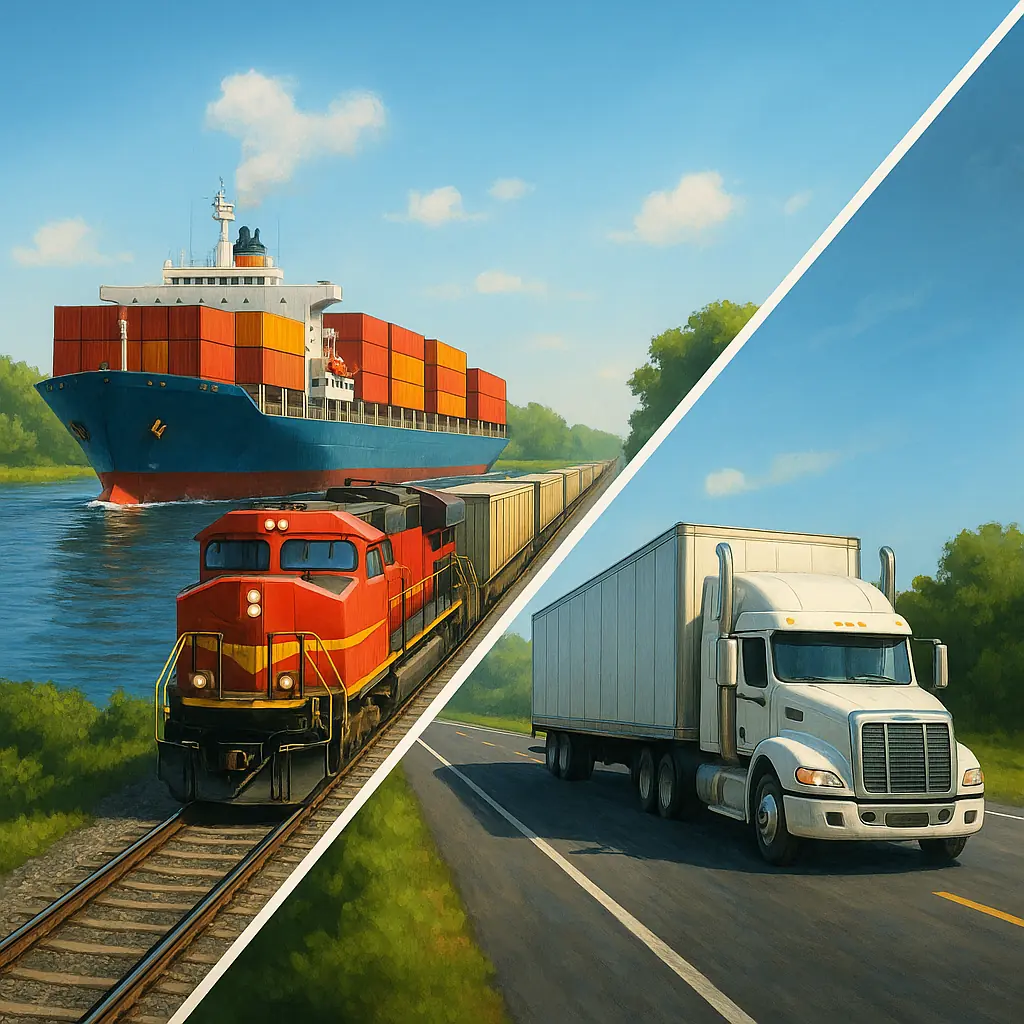
Imagine a country where highways hum less and canals and rails carry the majority of goods. Fewer semis, more barges, longer freight trains passing through towns instead of convoys clogging the interstate. It sounds tidy, clean, almost inevitable when you think about energy per ton moved.
Reality would be messy. The change would cut emissions and accidents. It would also force a massive rewiring of logistics, labor markets, and port and land-use planning. Here’s a clear-eyed look at whether rail and waterways could actually replace most truck freight, what would have to happen, and how to survive the transition.
Timeline of consequences
Pilots, incentives, and the first chokepoints
Governments start nudging freight away from long-haul trucking. Incentives for intermodal terminals, tax credits for barge upgrades, and pilot corridors appear. Shippers test consolidated loads and slower schedules to assess cost tradeoffs. Urban last-mile remains mostly trucks, but delivery windows stretch.
Key bottlenecks become obvious: insufficient intermodal capacity at inland hubs, a lack of electrified rail yards, and aging locks and dredging needs on key waterways. Early winners are bulk commodities and noncritical container flows that tolerate slower delivery.
Scaling infrastructure and reorganizing logistics
Major investments roll out. Governments spend on rail double-tracking, longer passing sidings, upgraded terminals, and dredging. Shipping lines and railroads form tighter partnerships. Rail freight corridors become more reliable and predictable.
Shippers redesign supply chains for longer lead times. Warehouses migrate toward rail heads and ports. Trucking consolidates into short-haul distribution, last-mile fleets, and specialized fast-response categories like emergency supplies and high-value perishables.
Optimization, automation, and workforce shifts
Automation and smarter scheduling reduce transshipment time. Electrified or low-emission locomotives replace many diesel engines where grid carbon intensity allows. Inland waterways see more automated barges and improved lock turnarounds.
Employment patterns shift. Long-haul driving jobs decline while demand for terminal operators, rail maintenance crews, dredging teams, and last-mile drivers grows. Retraining programs and social support are large political issues.
A new freight landscape, with caveats
If policy, capital, and geography align, most long-distance, non-urgent freight flows by rail and water. High-density corridors resemble transit networks for goods, not people.
But limitations remain. Last-mile complexity, point-to-point speed, and regions without navigable waterways still depend on trucks. Extreme weather, single-track vulnerabilities, and geopolitical disruptions create new fragilities that planners must manage.
What science says
At the physics level, moving mass on steel or water is cheap. Steel wheels on rails have far lower rolling resistance than rubber on asphalt. Barges glide with tiny friction relative to road vehicles. That matters when you calculate energy per ton-kilometer. Rail commonly uses multiple times less energy than trucks. Barges can be an order of magnitude more efficient for suitable loads.
Efficiency isn't the whole story. Speed, route flexibility, and handling cost matter. Trucks deliver door-to-door and can be rerouted in hours. Rail and water need hubs and transfers. Every transfer adds time, labor, and probability of damage. For high-value, time-sensitive goods, that margin often outweighs energy savings.
Infrastructure capacity is a physical hard limit. Rail networks are constrained by single-track segments, grade, and terminal throughput. Waterways are constrained by draft, lock size, and seasonal variations like drought or freeze. Upgrading ports, dredging rivers, and electrifying yards requires capital, environmental permits, and years of construction.
Emissions reductions are real but conditional. Shifting freight to electric rail or low-carbon barge fuel cuts CO2 per ton moved substantially. The actual reduction depends on the electricity grid, fuel choices, and how much freight actually shifts. A realistic, well-executed modal shift could cut freight-sector emissions by a few tens of percent over a few decades, while also reducing road fatalities, congestion, and wear on public highways.
Could anything survive?
Transitioning most freight off trucks is not a single policy or a single technology. It is a suite of moves that affect companies, workers, and communities. Here are practical steps for different players.
- Policymakers: Price road use more accurately. Use congestion pricing, higher long-haul fuel taxes, or carbon pricing to reflect external costs. Fund intermodal hubs, dredging projects, and electrified rail yards with targeted public investment. Design social programs for displaced drivers.
- Logistics firms and shippers: Redesign supply chains for predictability. Use cross-docking, scheduled block trains, and larger, slower shipments where lead times permit. Invest in terminal automation and real-time tracking to reduce transshipment delays.
- Truck drivers and unions: Push for retraining programs. Opportunities will grow in terminal operations, rail crew roles, maintenance, and last-mile electric delivery. Negotiate phased transitions with income support, certification programs, and job-placement services.
- Cities and regional planners: Reuse freed-up truck parking and distribution lots for housing, green space, or local delivery hubs. Plan for cleaner last-mile fleets like electric vans and micro-consolidation centers near rail heads.
- Environmental managers: Protect aquatic habitats when planning dredging or lock expansion. Require best practices for invasive species and sludge disposal during waterway upgrades.
Likely outcomes are a quieter, safer road network and lower freight emissions where grids and fuels are clean. Speculative outcomes include wholesale economic restructuring in regions dependent on long-haul trucking and new chokepoints where rail or canals concentrate risk. The transition will be incremental and politically contested. Prepare for uneven regional results and plenty of unexpected bottlenecks.