Survival meter
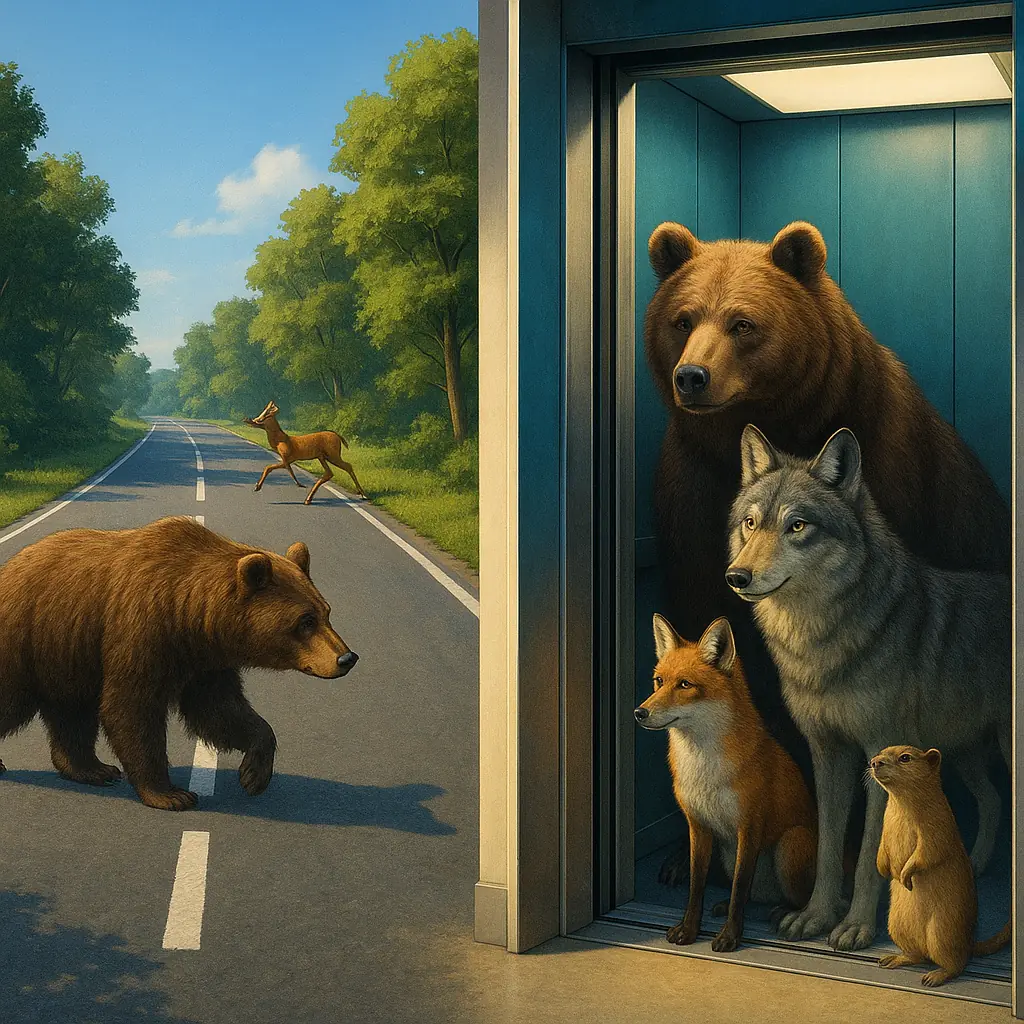
Picture raccoons queuing at the crosswalk, pigeons waiting for the 'walk' signal, crows stepping into elevators and tapping buttons with beaks. Not a cartoon. A behavioral shift where wild animals routinely use human transport infrastructure would rewrite parts of city life.
Some species already exploit roads, sidewalks, and urban structures. Expand that ability into routine, intentional use of roads and elevators and you get new patterns of movement, new conflicts, and new opportunities for both animals and people.
Timeline of consequences
Curious trials and local headlines
Individual animals test the novelty. A bold raccoon slips across a quiet street at night. A family of macaques rides an outdoor service elevator in search of food. Social media lights up. Scientists and animal control teams start collecting footage.
- Scattered incidents of animals pressing buttons or following people onto transit platforms.
- Localized traffic slowdowns and a spike in curious onlookers.
- Municipal agencies issue safety reminders and start data collection.
Social learning spreads the trick
Animals that benefit from the new behavior teach others. Young animals observe adults boarding elevators or crossing roads with timed lights. For species with strong social learning, adoption accelerates.
- Urban-adapted species like raccoons, crows, pigeons, foxes and some primates show the fastest uptake.
- More animals appear in areas previously avoided, such as commercial lobbies and parking garages.
- First wave of human responses: signage changes, restricted access hours, and small engineering fixes like pressure-sensitive mats that ignore non-human weights.
Infrastructure and policy adapt
Municipal planners and building managers start rewriting rules. Sensors and AI-assisted doors are tuned to detect animals. Traffic law enforcement focuses on conflict hotspots instead of individual sightings.
- Elevators get animal-aware programming that waits or skips floors based on weight and behavior patterns.
- New ordinances curb feeding in public spaces and mandate wildlife-proof trash and parking designs.
- Insurance and transit operators update risk models; some rides and delivery routes are altered at animal-heavy hours.
A reshuffled urban ecosystem
Habitats fragment and reconnect along human transit corridors. Some species thrive in the niche created by shared infrastructure. Others are outcompeted or decline because of increased exposure to humans.
- Cultural norms evolve: people learn to coexist with animals that take elevators up to roof gardens or nap on quiet office floors after hours.
- New urban morphologies appear, with dedicated wildlife corridors that interface smoothly with roads and vertical transport.
- Ecological consequences cascade: seed dispersal patterns change, predator-prey dynamics shift, and zoonotic risk fluctuates.
What science says
Animals learning to use roads and elevators is not magic. It rests on well-documented learning mechanisms: associative learning, trial and error, and social transmission. Corvids and primates are textbook examples of species that pick up complex tasks from observation. Raccoons already manipulate latches and doors. Pigeons navigate urban grids with uncanny precision. Those capabilities mean the baseline is closer than most people assume.
Elevator use requires a few skills. An animal needs to identify an entry, tolerate enclosed spaces, trigger a control, and read cues about doors opening. For many species, the simplest route is mimicry. One animal steps in, the doors close, the car moves, and the group learns the pattern. Operant conditioning then cements the behavior when it yields food, safety, or access to sheltered roosts.
Road use is familiar, but intentional road-crossing timed to signals is a different matter. Animals that can time movement with traffic flows reduce mortality. Success here depends on perceptual timing and risk assessment, skills that vary widely among taxa. Fast-breeding generalists adapt quickly. Specialized or shy species do not.
There are limits. Large mammals that rely on long-range spatial memory, like elephants or wolves, may ignore elevators because vertical transport interferes with their navigation cues. Nocturnal species that avoid human hours may never adopt daytime elevator use. Pathogens could hitch rides, but existing sanitation reduces most of that risk. The big unknown is how mixed-species interactions in confined human infrastructure influence behavior over generations. Evolutionary shifts are unlikely in the short term. What changes faster is culture, both animal and human.
Could anything survive?
If animals routinely use roads and elevators you can expect a mix of nuisance, danger, and wonder. Here are practical steps to stay safe and keep ecosystems healthy.
- Drive like animals are already on the road. Slow down in known wildlife corridors and at night. Watch shoulders and medians where animals may emerge.
- Close the door. Don’t leave elevators or stairwell doors propped. Animals exploit open pathways to access food and shelter.
- Manage attractants. Secure trash, stop feeding wildlife, and store pet food indoors. The fewer incentives animals have to enter buildings, the lower the conflict.
- Modify elevators and lobbies. Install weight and motion sensors that can distinguish small animals, retrofit doors to detect unintended closures, and create animal diversion zones away from busy human floors.
- Train building staff. Porters and concierges should know humane ways to coax animals out, call wildlife services, and block repeat entry points.
- Legal and ethical choices. Avoid lethal removal unless public safety demands it. Nonlethal exclusion and habitat modification scale better and reduce long-term conflict.
Prepare for uneven outcomes. Some neighborhoods will become tolerant and even proud of urban wildlife. Others will push for strict exclusion. If you live in a high-rise, keep balconies sealed and supervise pets. If you commute by car or bike, expect odd moments where a raccoon waits at a curb like any other jaywalker.