Survival meter
Imagine rain that never really stops, skies that stay heavy, rivers that creep into suburbs and cities, and forests that turn into endless swamps. Not just a few wet seasons, but a climate regime where humidity, standing water, and saturated soils are the new normal.
Some creatures would thrive. Others would vanish. This scenario looks at who wins, who loses, how ecosystems reorganize, and what humans would actually have to do to survive and prosper.
Timeline of consequences
Immediate disruption and opportunists
Flooding hits low-lying areas first. Mosquitoes, midges, and other short-generation insects explode in number. Fish move into flooded fields and city canals. Anywhere water pools, scavengers and generalists show up fast: rats, gulls, raccoons, and opportunistic herons.
Habitat reshuffle and disease pressure
Soils become anoxic in many places. Farmland yields collapse where crops cannot tolerate constant saturation. Wetland species expand their range. Water-borne pathogens and parasites rise, changing mortality patterns for humans, livestock, and wildlife. Aquatic plants and algae alter light regimes and oxygen levels in shallow waters.
Winners consolidate, specialists fall back
Amphibians, aquatic invertebrates, and fish diversify into newly available niches. Birds adapted to wetlands, like ducks, ibises, and herons, become more common across temperate zones. Terrestrial specialists that depend on dry ground, such as many rodents and large ungulates, retreat to hilltops and isolated dry patches or go extinct locally.
Ecosystems reassemble, human systems adapt
Mangroves and freshwater swamp forests extend inland where salinity allows. New disease regimes and food webs stabilize. Humans develop large-scale floating infrastructure, expansive aquaculture, and water-adapted agriculture, but at high economic and human cost. Some cities relocate to higher ground permanently.
Evolutionary winners and losers
Natural selection favors traits for swimming, aquatic reproduction, and tolerance of low oxygen soils. Expect more semi-aquatic mammals, shell-less snails adapted to constant water, and birds with broader foraging behaviors. Many dry-land specialists survive only in isolated refuges or as relict populations.
What science says
Perpetual wetness could come from a long-term shift in the atmosphere's water content, a stationary pattern of low pressure and slow-moving storms, or human-driven changes that alter evapotranspiration and drainage. Warmer air holds more moisture, so a hotter planet tends to deliver heavier precipitation. If precipitation outpaces evaporation and drainage, landscapes saturate and standing water becomes widespread.
Wet conditions change physics and chemistry. Saturated soils lose oxygen. Plant roots drown, favoring species with aerenchyma or adventitious roots. Decomposition slows or shifts to anaerobic pathways, increasing methane and hydrogen sulfide emissions in some wetlands, or expanding peat formation where plant production remains high. Surface water expansion alters light and temperature regimes, favoring aquatic primary producers like algae and emergent macrophytes.
Biology follows. Aquatic and semi-aquatic organisms have several advantages: life stages that tolerate or require water, reproduction without dry-soil dependency, and feeding strategies suited to suspended or benthic food webs. Conversely, many terrestrial predators and foragers that rely on dry ground, visual hunting in open landscapes, or burrowing will lose habitat and resources.
Could anything survive?
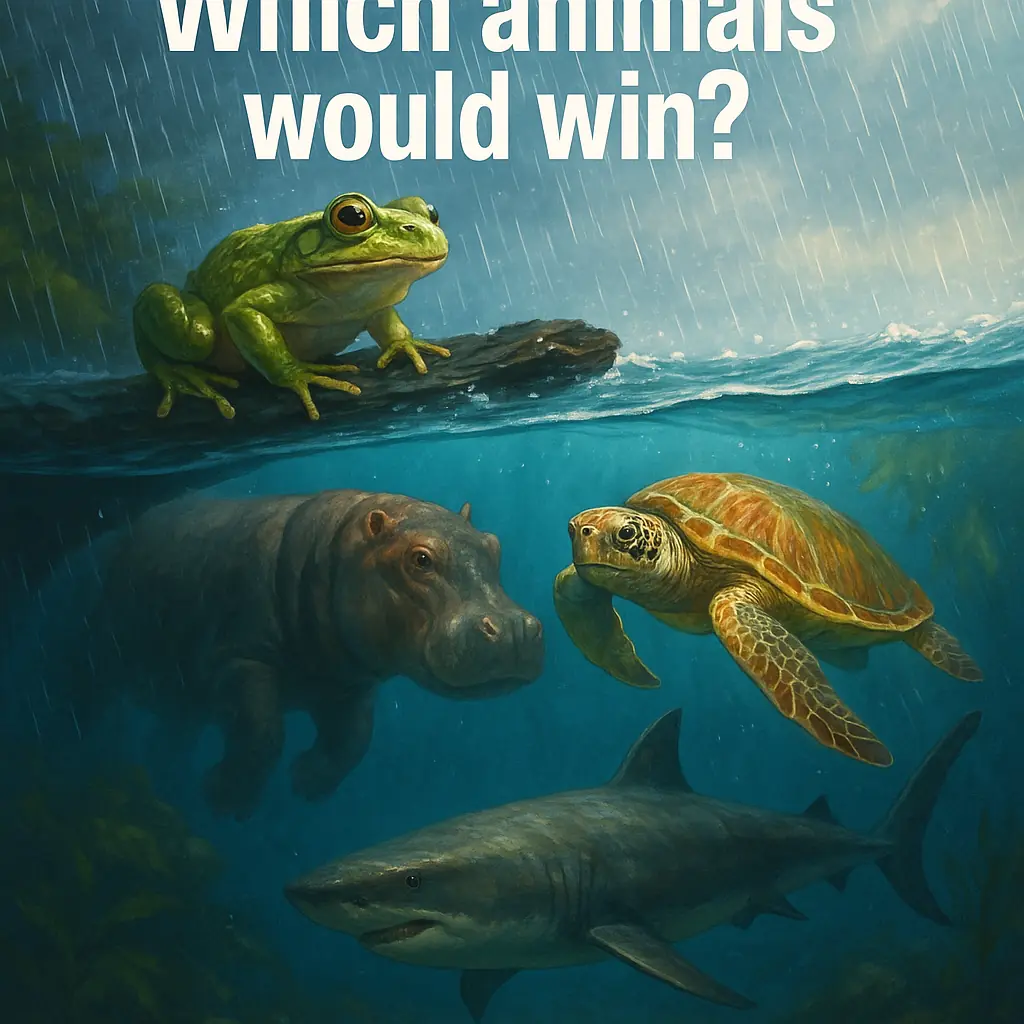
Winners share traits: they breed fast in water, disperse through floodwaters, tolerate low-oxygen substrates, and exploit detritus or plankton. Amphibians are obvious candidates. Frogs and salamanders will expand where breeding ponds and marshes proliferate, though disease risks like chytrid fungi may still cull some species.
- Fish and crustaceans: Freshwater fish, shrimp, crabs, and crayfish colonize new inland waters. Species with broad salinity tolerance can move between coastal and inland habitats.
- Aquatic birds: Ducks, grebes, herons, and gulls thrive because food is abundant and open water replaces dry foraging grounds.
- Semi-aquatic mammals: Otters, beavers, muskrats, water buffalo, and certain rodents expand where their engineering or grazing opens habitat and captures resources.
- Invertebrates: Mosquitoes, midges, water beetles, and mollusks proliferate. Many are short-lived and prolific, allowing rapid ecological responses.
Losers include terrestrial specialists that depend on dry soils and a stable tree canopy, such as many ground-nesting birds, burrowing mammals, and insects that need dry pupation sites. Large grazers that cannot swim or find sufficient forage on dry land will decline in many regions.
For humans, survival is practical engineering and public health. Raise living areas, redirect water through canals and levees where possible, and shift food production to aquaculture and wetland-tolerant crops like taro, water rice, and certain grasses. Mosquito control, improved sanitation, and vaccines become priorities.