Survival meter
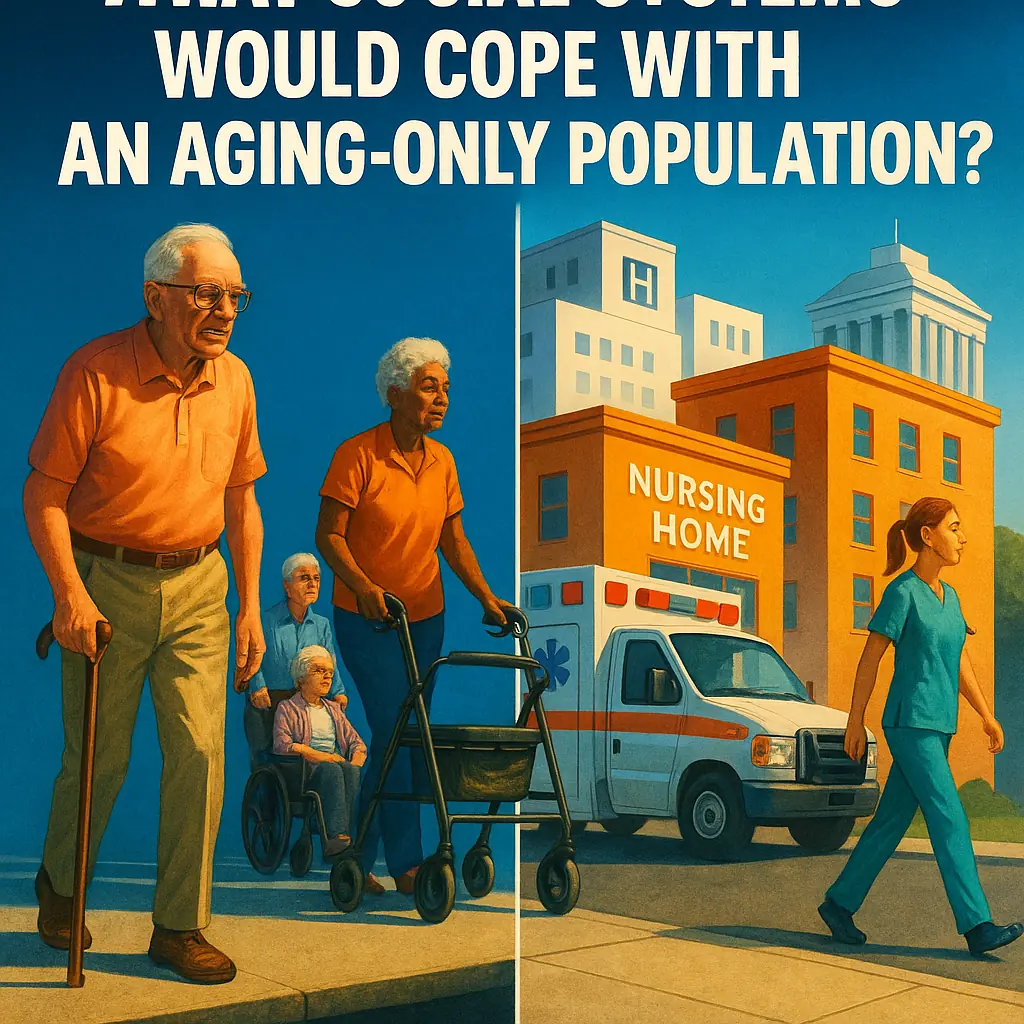
Imagine a world where births plummet and almost every new citizen is old. Not a sudden apocalypse, but a steady slide toward an older, greyer population. Fewer children, longer lives, and a society rearranged around longevity. The pressures would be immediate and persistent: finances stretched, care networks strained, politics reweighted, cities redesigned.
Here I map how institutions bend, break, or adapt when the young stop arriving in meaningful numbers. Expect policy stitches, technology patches, social bargains, and some hard trade offs. Not every outcome is plausible. Some are likely. Some are only possible if certain choices are made.
Timeline of consequences
Shock and scrambling
Governments and firms face a visible spike in dependency ratios. Pension systems show deficits, healthcare demand rises, and household budgets tighten. Politicians promise solutions. Short-term fixes dominate.
- Emergency fiscal moves, like tapping sovereign funds and cutting nonessential spending.
- Workplace changes: phased retirement, part-time roles for seniors, and incentives to keep older staff on payroll.
- Private sector ramps up home-care services and consumer products for mobility and comfort.
Policy reprioritization and technological substitution
Clearer patterns emerge. Countries with flexible labor markets and strong fiscal buffers adapt faster. Automation and digital health scale to reduce labor pressure. Migration debates intensify.
- Pension reform: later retirement ages, indexation changes, and means-testing become common.
- Automation fills routine jobs, while care roles attract public subsidies and professionalization drives.
- Urban planners retrofit housing and transport for accessibility, not just for a minority of retirees but for a large fraction of the population.
New social contracts and political friction
As older cohorts dominate electorates, policy preferences skew toward healthcare, security, and stability. Tension rises over resource allocation between generations. Some societies craft explicit intergenerational compacts; others fragment.
- Education budgets shrink in many places, creating skills gaps for sectors that still require youth-driven innovation.
- Electoral clout of older voters leads to more conservative fiscal choices in some countries, and more expansive welfare nets in others.
- Communities reinvent living arrangements, with multigenerational hubs and cooperative care models restoring some interdependence.
Demographic and economic reconfiguration
Population decline becomes visible. Cities downsize, suburbs age. Economies settle into different productivity patterns. Cultural life shifts as youthful innovation dips but experience-driven industries thrive.
- Labor shortages push wages in certain sectors, potentially spurring more automation and remote work models that import skills virtually.
- Health systems pivot from acute care to chronic-care management and prevention focused on extending healthspan rather than just lifespan.
- Inheritance patterns alter wealth distribution, with potential concentration unless taxes or social programs redistribute resources.
Stabilization, adaptation, or decline
Outcomes diverge by policy choices made earlier. Some nations stabilize with smaller, older but healthy populations. Others face economic contraction, shrinking military and scientific capacity, and weakened global influence.
- Countries that embraced migration, lifelong learning, and automation sustain economic productivity, even with fewer people.
- Places that resisted change may endure decades of stagnation, slow infrastructure decay, and weaker public services.
- Smaller populations reduce environmental pressure, but land-use shifts and abandoned urban spaces create management challenges.
What science says
Demography is simple arithmetic and complex feedbacks. Fertility below the replacement rate, combined with rising life expectancy, raises the old-age dependency ratio: more non-workers per worker. That drives fiscal stress on pension and healthcare systems because obligations are front-loaded while tax bases shrink.
Healthspan matters more than lifespan. If people live longer but with decades of frailty, care costs explode. If medical advances compress morbidity into a short period at the end of life, the pressure eases. Both outcomes are plausible, and policy can nudge which one emerges.
Technological change is a wild card. Robotics, AI, and telepresence reduce the need for young manual labor. They also change the skill mix required, benefiting agile retraining systems. Migration can offset demographic decline, but political and cultural factors govern how much it helps.
- Economic growth with fewer people is possible if productivity rises fast enough. High automation and investment in human capital can sustain per capita living standards.
- Cultural innovation often bubbles up from younger cohorts, so creative industries and scientific renewal may slow unless institutions create incentives for cross-generational collaboration.
- Environmental impacts are ambiguous. Fewer people typically mean lower aggregate emissions, but older populations could raise per capita healthcare resource use, altering the net effect.
Could anything survive?
Surviving in a world skewed old does not mean heroic isolation. Societies and individuals can take clear actions that make coping realistic rather than ruinous.
Policy levers for governments
- Reform pensions toward sustainability: gradual retirement age increases tied to health metrics, partial pensions, and stronger incentives for saving.
- Invest in healthspan: prioritize prevention, chronic disease management, and community-based care to reduce costly hospitalizations.
- Encourage flexible migration policies aimed at balanced age mixes and targeted skills. Political consensus matters more than marginal economic gains.
- Fund lifelong learning, so older workers can transition to higher-value roles or mentor-driven positions that complement automation.
What communities and cities should do
- Design housing for adaptability: smaller units that can be combined, accessible public spaces, and local service clusters to reduce travel burdens.
- Scale community care cooperatives and local tech-assisted caregiving solutions to keep people independent longer.
- Repurpose underused infrastructure into green corridors, shared facilities, and low-energy maintenance zones.
Individual strategies
- Plan finances with conservative longevity assumptions, delay claiming pensions if possible, and maintain diversified income sources.
- Invest in skills that are hard to automate: social intelligence, complex judgment, craft, and caregiving competencies.
- Build local social networks that can provide mutual aid for transport, chores, and companionship.
Expect trade offs. Sacrifices will be political and personal. Societies that choose exclusionary, protectionist responses risk economic decline and cultural stagnation. Those that embrace migration, automation, and sustained public investment in health and learning can preserve high living standards with fewer people.